





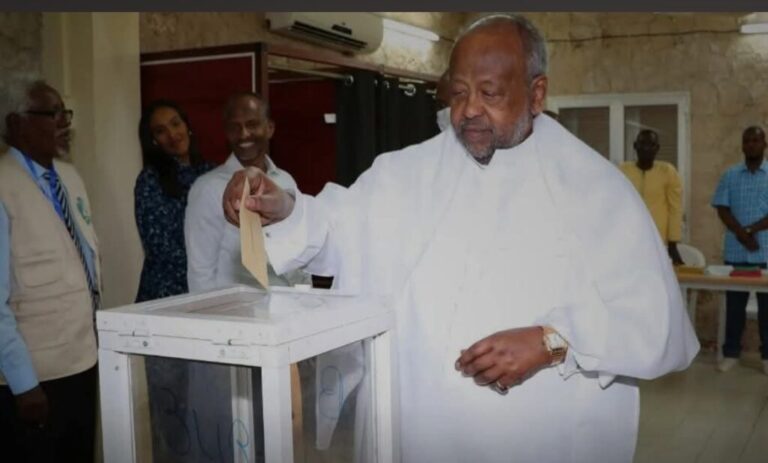
Djiboutian voters have been heading to the polls on Friday to elect a new president, in a vote monitored by regional and international observers.
The election is largely dominated by incumbent president Ismaïl Omar Guelleh, who has been in power since 1999.
At 78, Guelleh is seeking a sixth term following a constitutional revision adopted in 2025 that removed the age limit for presidential candidates.
He faces a single challenger, Mohamed Farah Samatar, the Unified Democratic Centre (CDU) candidate.
The vote is taking place against the backdrop of a low-profile by the opposition and limited electoral competition, according to observers.
The Djiboutian authorities have announced the deployment of 67 international observers tasked with overseeing the election. According to the Ministry of Foreign Affairs and International Cooperation, the observers are mainly from the African Union, the Intergovernmental Authority on Development, the Arab League, and the Organisation of Islamic Cooperation.
The African Union mission, comprising 47 observers, is led by Bernard Makuza, while the IGAD team, made up of 16 members, is headed by Mulatu Teshome. The Arab League and the OIC have each deployed two observers.
According to the authorities, these missions are mandated to conduct an independent, impartial, and objective assessment of the electoral process, and to engage with candidates, political authorities, and institutions responsible for organizing the vote.
In parallel, the IGAD observer mission—which includes the organisation’s Deputy Executive Secretary Mohamed Abdi Ware—held consultations with the committee of ambassadors, the African Union mission, Djiboutian civil society, and the Independent National Electoral Commission (CENI). Training sessions were also organised for observers ahead of the vote.
During the campaign period, both candidates conducted nationwide electioneering.
President Guelleh, running under the banner of the Union for the Presidential Majority (UMP), held rallies in Dikhil and Ali Sabieh, highlighting priorities such as economic growth, youth employment, and public services.
His challenger Samatar launched his campaign in Tadjourah before continuing in Obock, calling for political renewal and greater citizen participation.
The election follows the Djiboutian parliament’s decision to lift the constitutional age limit for presidential candidates.
Official results are expected after the vote.
AC/Sf/lb/as/APA