



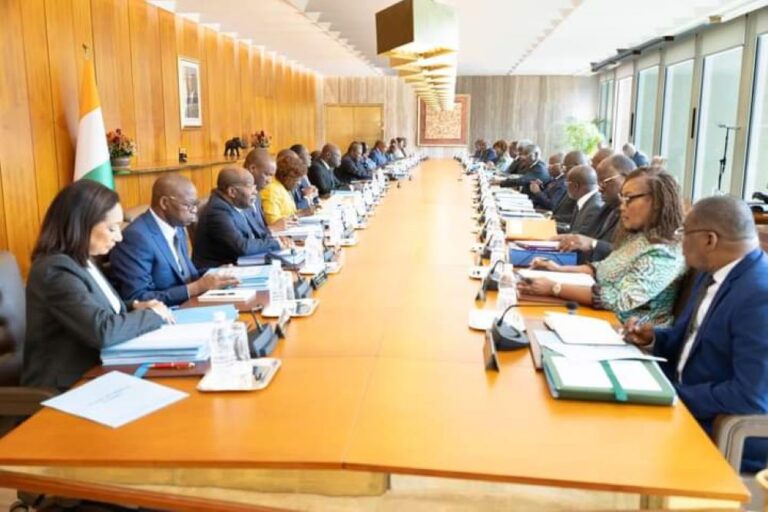
The Ivorian political landscape is undergoing a major shift.
Following the legislative elections of December 27, 2025, Prime Minister Robert Mambé submitted his resignation and that of his cabinet to President Alassane Ouattara on Wednesday, a move which has been accepted.
The official announcement regarding the resignations was made by Masséré Touré-Koné, the Secretary-General of the Presidency. This move comes in the wake of the legislative polls and in a context of political reconfiguration, as several members of the outgoing executive were elected as deputies in the recent parliamentary vote.
President Ouattara, who was re-elected last October, formalised the transition by signing several decrees of significance. The first decree terminates the functions of the PM and the entire government.
Concurrently, a second decree ends the terms of the Ministers-Governors of the Autonomous Districts, signaling a strong intent for a deep renewal of the country’s governing bodies.
The presidency was not spared: President Ouattara also signed a decree ending the functions of the Ministers of State, Ministers, and Ministers-Advisors at the Presidency of the Republic.
The Ivorian leader was keen to express his gratitude to Robert Beugré Mambé and his ministers for their “important contribution to the socio-economic development of Cote d’Ivoire.”
He also commended the commitment of the Ministers-Governors in service to the nation.
However, to prevent any vacuum of power, the outgoing PM and members of the erstwhile government are mandated to manage current affairs.
This interim period will last until the appointment of a new head of government and a new ministerial team.
This collective resignation paves the way for a major cabinet reshuffle. Political observers are now waiting to see what direction President Ouattara will give to this future government, especially as the new balances resulting from the 2025 legislative elections will have to be taken into account to address the challenges of 2026.
AP/sf/lb/as/APA