



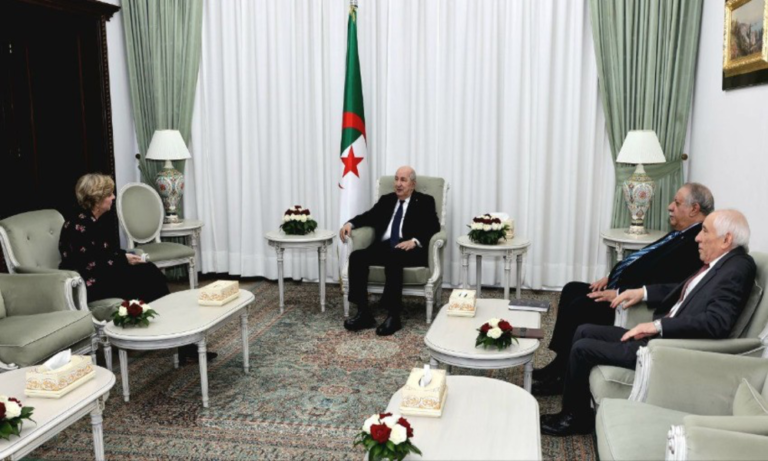
President Abdelmadjid Tebboune’s reception of the outgoing United States Ambassador marked a classic diplomatic exercise, characterized by warm statements that nonetheless leave the real fragilities and limitations of the Algerian-American partnership unresolved.
President Tebboune received U.S. Ambassador Elizabeth Moore Aubin in Algiers for her farewell visit, after four years at the helm of the American diplomatic mission.
Following the audience, the diplomat praised the “solidity” and “historical depth” of bilateral relations before the press. This conventional discourse thinly masks the absence of major strategic breakthroughs between the two countries.
Ms. Aubin highlighted her personal attachment to Algeria, recalling that she previously served there between 2011 and 2014 as Deputy Chief of Mission. “The Algerian people will always be in my heart,” she declared, insisting on a relationship she described as a “fruitful experience.”
This emotional register, largely mobilised in diplomatic farewells, contrasts with a bilateral cooperation that has remained essentially declarative on several fundamental issues.
The diplomat also recalled that relations between the two countries date back to the 18th century, with Algeria being one of the first partners of the young American state after U.S. independence, preceding the signing of a Treaty of Amity in 1995. “The ties between my country and Algeria are strong,” she affirmed, referencing a partnership covering cultural, economic, scientific, and security domains.
Behind this institutional rhetoric, however, observers note a persistent gap between the discourse and the reality. Economically, trade remains limited and is largely dominated by hydrocarbons, lacking structural American investments commensurate with the potential displayed by Algiers. Politically, divergences remain notable, particularly concerning issues of governance, public liberties, and Algeria’s regional positioning.
On the security front, often presented as the cornerstone of the partnership, cooperation remains pragmatic yet cautious. Algeria is zealously committed to preserving its strategic autonomy and avoiding any alliance perceived as asymmetric. While this posture reinforces the government’s sovereignist discourse, it also limits the deepening of a more integrated partnership with Washington.
Elizabeth Moore Aubin’s farewell visit thus illustrates the permanence of a polite and stable diplomatic relationship, but one marked by a form of strategic stagnation. Despite the declarations of friendship and mutual respect, the Algerian-American relationship remains confined to minimal cooperation, far from the stated ambitions and without any notable inflection during the Tebboune presidency.
MK/sf/lb/as/APA