





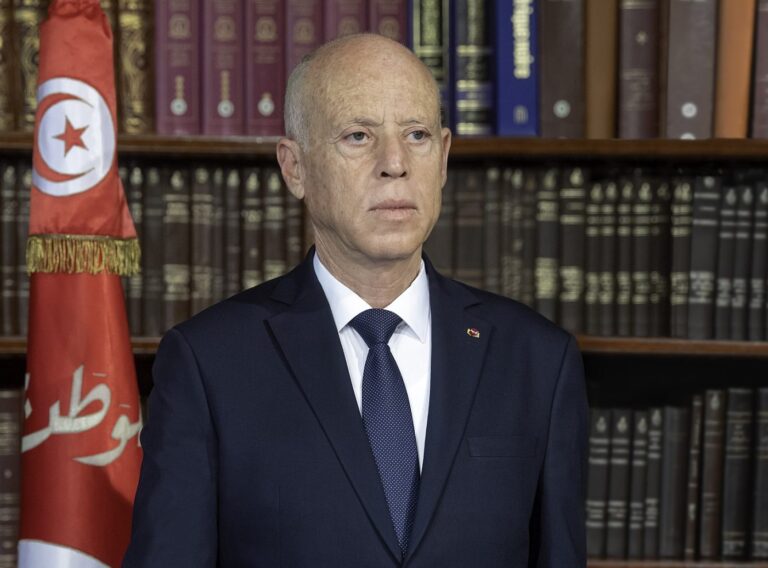
The Tunisian President praised the national army’s involvement in several civilian projects, underscoring the military institution’s growing footprint in the management of economic and territorial affairs.
Tunisian President Kaïs Saïed received Defense Minister Khaled Shili at Carthage Palace on Tuesday for a meeting focused partly on the role of the army in public projects and community support operations.
In a statement, the Presidency noted that the Head of State had commended the armed forces for their “immeasurable efforts” in defending the country and assisting citizens when circumstances demand it.
Beyond its traditional defense mandate, the Tunisian military is being called upon with increasing frequency in civilian domains notably through the Directorate General of Military Engineering, which has been involved in delivering a number of infrastructure projects across various regions of the country.
President Saïed highlighted the armed forces’ contribution to development programmes, which authorities have framed as a way to accelerate the delivery of certain public works.
This expanding involvement of the military in civilian project management reflects a specific context in Tunisia, one defined by persistent economic difficulties and administrative bottlenecks that routinely slow the progress of infrastructure initiatives. In that setting, the authorities appear to be leaning increasingly on state structures perceived as more operationally efficient to work around delays and institutional blockages.
During the meeting, the president also reviewed the activities of the Rjim Maatoug Office for the Development of the South and Sahara, an institution mandated to promote the development of desert regions.
Saïed called for greater support for the body with the aim of turning
Tunisia’s Sahara into productive agricultural zones pointing to trials that have demonstrated the potential of these territories for fruit and vegetable production.
This ambition to unlock the agricultural potential of the country’s south is not new. For several years, Tunisian authorities have emphasized the opportunities offered by exploiting water resources and Saharan land. Yet these projects continue to face structural headwinds, particularly around infrastructure, water management and financing.
Against this backdrop, the emphasis placed on the army’s role in economic and territorial programmes reflects a political strategy that is gradually expanding the military’s scope of action beyond the strictly security-related sphere.
While the authorities present this orientation as a pragmatic response to urgent development needs, it also speaks to the enduring limitations of the civilian administrative apparatus in driving certain strategic projects forward.
MK/AK/Sf/lb/gik/APA