





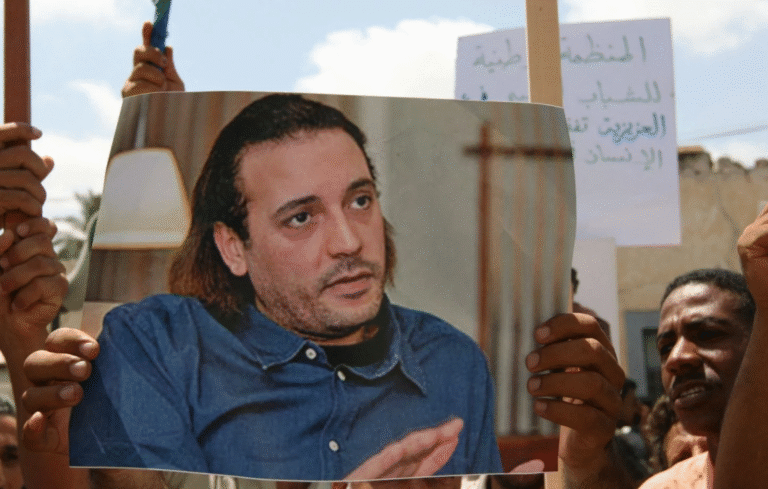
Hannibal Gaddafi, the son of the late Libyan leader Muammar Gaddafi, was released from detention in Lebanon on Monday after nearly a decade behind bars, his lawyer, Laurent Bayon, reports confirmed.
His release was secured after he posted a bail amount of $900,000 (approximately €830,000), significantly lower than the $11 million initially demanded by the Lebanese courts.
An economics graduate, Hannibal Gaddafi fled Libya in 2011 following the fall of his father’s regime, eventually seeking refuge in Syria before his arrest in Lebanon in 2015.
Gaddafi was arrested in Beirut and prosecuted in connection with the investigation into the 1978 disappearance of Lebanese Shiite leader Moussa Sadr. Lebanese authorities suspected that his father played a role in the long-unsolved case. Despite ten years in custody at Roumieh, the country’s main prison, the son of the former Libyan dictator was never brought to trial.
His lawyer, Laurent Bayon, characterized the release as “the end of a ten-year nightmare.” Bayon had repeatedly criticized his client’s detention conditions and denounced the lack of judicial independence, stating that Hannibal Gaddafi was held without trial for reasons that were “more political than legal.”
The initial bail set by the investigating court was $11 million, which the defense labeled as “disproportionate” before it was revised last week, culminating in the agreement signed on Monday.
Now 49, no details regarding Hannibal Gaddafi’s immediate destination were disclosed; his family cited “confidentiality” for security reasons. Since his father’s death in 2011, he has been implicated in several legal cases across Europe, particularly in France and Switzerland.
His name remains on the list of individuals subject to UN and European Union sanctions imposed since 2011, which include asset freezes and movement restrictions. While his release concludes a long period of isolation, his legal and diplomatic future remains uncertain. The Moussa Sadr case, nearly half a century old, continues to be one of the most sensitive political issues between Beirut and Tripoli.
MK/Sf/fss/abj/APA