





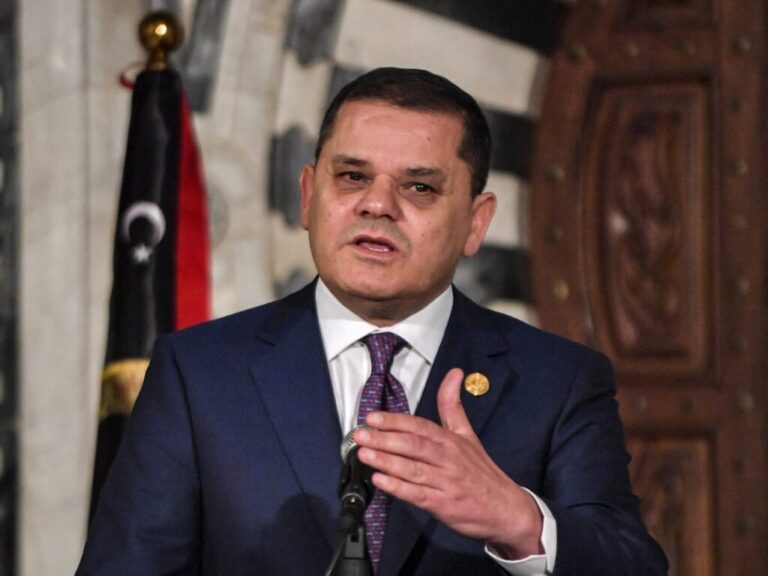
Libyan Prime Minister Abdul Hamid Dbeibah chaired the first ordinary meeting of the General Assembly of the General Electricity Company of Libya (GECOL) for 2025 on Monday.
The high-level meeting focused on evaluating the sector’s current performance and planning strategic projects to overhaul the country’s fragile energy infrastructure.
Held at the Prime Minister’s Office, the meeting included GECOL’s Chairman of the Board, Mohammed Al-Mashai, the Director General, and members of the General Assembly. Officials reviewed recent achievements across electricity generation, transmission, and distribution, as well as new measures adopted to improve grid efficiency and meet the nation’s rapidly increasing energy demand.
The Board of Directors presented a detailed report on contracted and ongoing projects, many of which are specifically aimed at boosting generation capacity and reducing recurring power outages.
Discussions were particularly focused on technical, logistical, and financial obstacles hindering the implementation of these projects, especially in the western and southern regions where infrastructure is most fragile.
Prime Minister Dbeibah stressed that the electricity sector remains a “top priority for the government, as it is essential for economic recovery and the quality of life of citizens.” He affirmed that the government would continue to fully fund strategic projects in the sector.
The Prime Minister urged GECOL to strengthen coordination across its various departments and adopt an integrated approach to grid management to meet deadlines and raise performance standards. He also advocated for the establishment of robust monitoring and accountability mechanisms to ensure measurable results in infrastructure improvement.
This push is part of a broader strategy designed to stabilize the national grid, diversify energy sources, and attract much-needed private investment in the production and maintenance of Libya’s electricity system.
Libya has grappled with frequent power outages for over a decade. The current production capacity stands at approximately 6,500 MW, significantly below the estimated peak demand of nearly 8,000 MW. The Government of National Accord is attempting to modernize the aging grid through major rehabilitation projects, notably with international partners like Siemens and General Electric, to improve service reliability nationwide.
MK/ak/ac/Sf/fss/abj/APA