



Algeria possesses genuine energy assets, but its ambition to become a sustainable engine of energy security remains fragile.
While the North African country is stepping up energy projects in Africa and announcing diversification plans toward Europe, this push masks persistent constraints: dependence on hydrocarbons, massive investment needs, uncertain cross-border projects, and an energy transition that remains embryonic.
Algeria seeks to reinforce its status as a regional energy supplier by relying on state-owned firms Sonatrach and Sonelgaz, expanding initiatives across Africa and Europe. Behind this offensive strategy, however, the country’s ability to convert these projects into a sustainable advantage remains uncertain.
The economy remains heavily exposed to hydrocarbons, while several infrastructures presented as strategic will still require considerable investment, complex international coordination, and years before reaching full capacity.
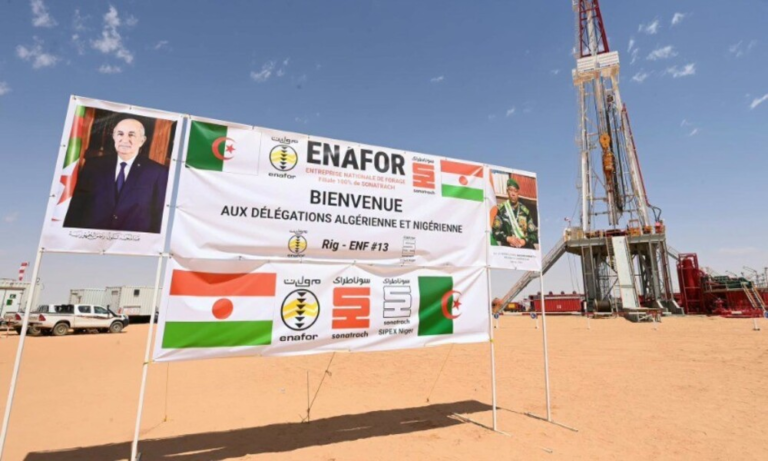
In Africa, Sonatrach is attempting to expand its footprint in the Sahel. On Friday, the national company completed its first deliveries of Jet A1 fuel from the Adrar refinery to Niger. The operation illustrates Algiers’ drive to strengthen its regional market outlets, but it comes within a Sahelian environment marked by political instability, security risks, weak infrastructure, and limited financial capacity—all factors likely to complicate turning these sporadic initiatives into sustainable commercial markets.
The Trans-Saharan Gas Pipeline (TSGP) encapsulates these uncertainties even more sharply. Stretching 4,130 kilometers with a theoretical capacity of 30 billion cubic meters per year, the project aims to transport Nigerian gas through Niger to Algerian infrastructure before its transit to Europe.
Work on the Algerian section was launched in June, but the financial scale of the project, the traversal of territories exposed to security threats, and the need for ongoing coordination among three states maintain questions over its timeline and economic viability.
At the same time, Algiers is deploying Sonelgaz in a costly African energy diplomacy initiative. A 40 MW power plant, consisting of two 20 MW gas turbines, was gifted to Niger and inaugurated in June at Gorou Banda.
A facility of equal capacity, fully funded by Algeria, is also planned for Chad. While these projects enhance Algiers’ diplomatic influence, they also raise questions about their cost for a state simultaneously required to modernize its own infrastructure and finance its energy transition.
MK/Sf/lb/as/APA