





The surprise visit of Turkey’s intelligence chief to Benghazi underscores Ankara’s gradual pivot toward eastern Libya—once an adversary—and opens the door to new strategic alignments.
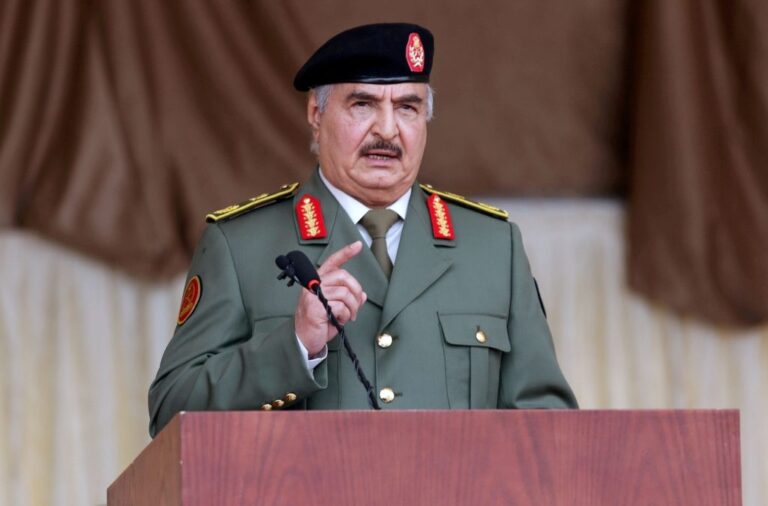
A scene unthinkable just a few years ago unfolded on Monday, 25 August, when Field Marshal Khalifa Haftar, the strongman of eastern Libya, hosted Turkish intelligence chief Ibrahim Kalin at his Benghazi headquarters, accompanied by a high-level military delegation.
It was the first such visit since 2020, marking another step in the quiet but steady thaw between Ankara and the Libyan National Army (LNA).
Haftar was flanked by his two sons, Saddam and Khaled, recently promoted within the LNA—Saddam as deputy commander-in-chief and Khaled as chief of staff. Their prominent presence signaled Haftar’s intent to consolidate their political and military legitimacy while positioning them as key figures in forging ties with foreign partners.
The LNA’s statement was terse, mentioning only “shared interests” and ways to advance them. Yet the symbolism of the encounter was unmistakable – Turkey, long the exclusive backer of the government based in Tripoli, has in recent months made overtures toward Benghazi.
In 2019, Kalin—then spokesperson for the Turkish presidency—had publicly denounced Haftar as a “coup plotter.” At the time, Ankara was providing drones and military advisers to shore up the UN-recognised Government of National Accord (GNA) in Tripoli against Haftar’s offensive.
The shift began in April 2025, when Saddam Haftar was received in Ankara by Turkey’s chief of staff. Since then, the signals of rapprochement have multiplied, driven by converging interests: Turkey seeking to expand its leverage across Libya to safeguard economic and energy stakes, and Haftar looking to reduce dependence on Cairo and Abu Dhabi by opening new channels of cooperation.
Talks held aboard the Turkish frigate that ferried the delegation to Benghazi confirmed that military cooperation was also on the table. For Ankara, it is about maintaining its status as a key powerbroker in Libya by engaging both camps. For Haftar, it offers greater strategic autonomy and bolsters his credentials as a legitimate interlocutor for regional powers.
The recent thaw between Turkey and Egypt provides further momentum. Ankara and Cairo now claim to share “a common vision” for Libya, both keen to avoid renewed conflict in a country where their security and economic interests increasingly converge.
If sustained, this rapprochement could accelerate the reshaping of Libya’s fractured political map. Turkey, eager to secure reconstruction contracts and safeguard energy assets, views eastern Libya as a strategic arena. For Haftar, it represents a chance to diversify alliances and move closer to international recognition.
For now, the initiative remains fragile, overshadowed by entrenched rivalries and lingering distrust. But the 25 August encounter highlights a defining truth about Libya: the balance of power is constantly shifting, driven by pragmatism and overlapping ambitions.
MK/sf/lb/as/APA