



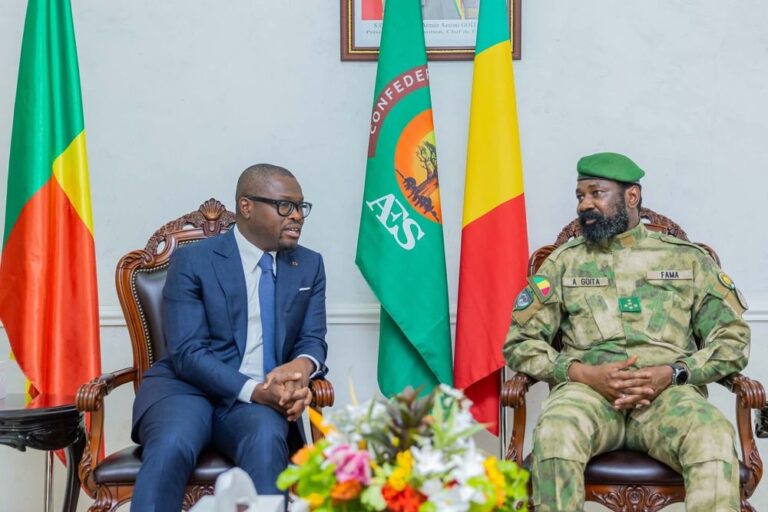
Beninese President Romuald Wadagni was received in Bamako on Tuesday by military ruler General Assimi Goita, for a friendly working visit focused on strengthening dialogue between the two countries.
Upon his arrival at President Modibo Keita International Airport in Senou, the Beninese head of state was greeted by his Malian counterpart with the honours due to his rank.
The ceremony included the playing of the national anthems and greetings from dignitaries and representatives of the Beninese community in Mali.
After an initial meeting at the presidential pavilion, the two leaders proceeded to the Koulouba Palace to continue their talks.
This visit to Mali is part of a regional tour undertaken by Romuald Wadagni since his inauguration on May 24, 2026, in Cotonou. Following visits to Nigeria, Niger, Burkina Faso, Togo, and Côte d’Ivoire, the President of Benin began a new series of trips on June 9th to Senegal, Mali, and Guinea-Bissau.
According to the Beninese presidency, these trips aim to strengthen economic and trade cooperation, consolidate solidarity among West African nations, and foster discussions on regional security issues.
The visit to Bamako comes amid a diplomatic realignment in West Africa. Mali, Burkina Faso, and Niger left Ecowas and joined the Alliance of Sahel States (AES), now a confederation.
Benin, a member of both Ecowas and UEMOA, is seeking to maintain dialogue with Sahelian countries, particularly after the tensions arising from the political and security crises that have plagued the region.
Cooperation between Mali and Benin remains less extensive than that maintained by Bamako with some of its neighbours with maritime access, such as Senegal, Côte d’Ivoire, and Togo.
However, it could be strengthened around three concrete areas:
regional security, economic exchanges, and transport corridors.
Economically, the Port of Cotonou represents a potential asset. It constitutes one of the main maritime access points to the West African hinterland and can offer Mali an alternative or complement to existing transit routes, even though the Dakar-Bamako, Abidjan-Bamako, San
Pedro-Bamako, and Lomé-Bamako corridors remain the most heavily used.
Diversifying supply routes remains a major challenge for a landlocked country, which regularly faces logistical delays, high transport costs, and tensions on certain road networks.
In terms of security, the two countries do not face the same realities, but they do confront a common regional threat. Mali remains at the heart of the Sahel crisis, while northern Benin has been under pressure for several years from armed groups operating near the borders with Burkina Faso and Niger.
This situation could foster exchanges in intelligence sharing, the fight against trafficking, border surveillance, and regional security cooperation.
Mali was represented at Romuald Wadagni’s inauguration by its foreign minister Abdoulaye Diop.
Bamako reaffirmed its willingness to build a relationship based on respect for the sovereignty of states and the interests of their populations.
Tuesday’s visit provides the first political expression of this desire for rapprochement and a
renewed dialogue between Bamako and Cotonou.
MD/te/fss/as/APA