





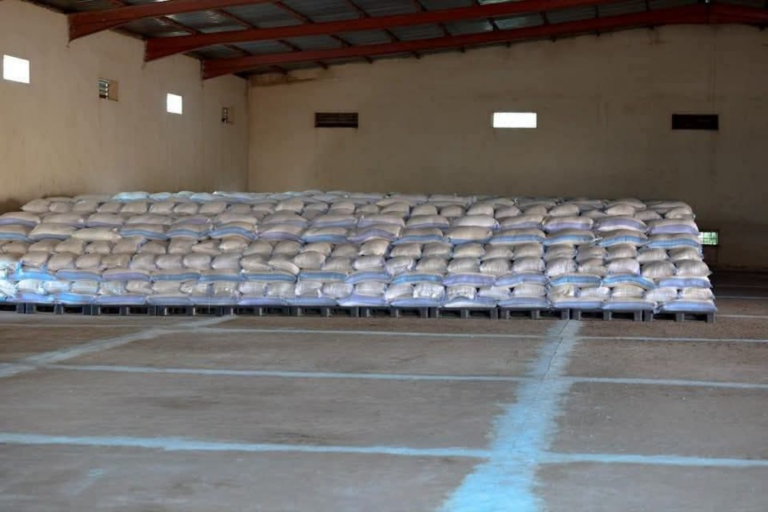
The Malian government has officially commenced the implementation of its 2026 National Response Plan (PNR), a 12.7 billion CFA Franc initiative aimed at curbing worsening food insecurity and acute malnutrition across the country.
The broad relief operation will distribute nearly 20,000 tonnes of cereals to more than 1.5 million vulnerable citizens during the lean season. Prime Minister Major General Abdoulaye Maïga officially launched the initiative at the Mali Agricultural Products Board (OPAM) on behalf of Transitional President General Assimi Goïta, immediately dispatching the first supply trucks to service the six municipalities of the capital, Bamako.
Prepared annually by the Food Security Commission, this year’s plan targets households facing crisis or emergency situations with the free distribution of 19,960 tonnes of essential cereals. To further alleviate economic pressure on low-income families, the programme includes subsidized sales of rice, millet, sugar, and cooking oil at half their market prices. The government intervention also addresses rural livelihoods by supplying 1,200 tonnes of livestock feed, over 424 tonnes of fish feed, and various vegetable seeds to help safeguard local production.
International partners and foreign allies are contributing substantially to bolster the national effort. The World Food Programme (WFP) is slated to provide direct assistance to over 365,000 individuals while supporting livelihood initiatives for another 185,000 beneficiaries, alongside targeted reach from the Food and Agriculture Organization (FAO) to over 86,000 people. Furthermore, China has donated 1,930 tonnes of rice to the state commission, and Russia has contributed 770 tonnes of split peas to WFP distribution streams.
The urgent rollout arrives as Mali contends with deteriorating living conditions, persistent insecurity, rising market prices, and supply constraints that particularly impact the northern and central regions. According to Harmonised Framework projections, acute food insecurity will affect approximately 1.6 million citizens this lean season, reflecting a 9 percent increase from the previous year. Health authorities also project that more than 1.1 million young children could suffer from acute malnutrition through late 2026, including roughly 227,000 severe cases. To tackle these systemic vulnerabilities long-term, the Food Security Commission plans to establish a dedicated Food and Nutrition Security Monitoring and Early Warning Agency alongside a new “Malian Food Facility” mechanism.
MD/te/Sf/lb/abj/APA