



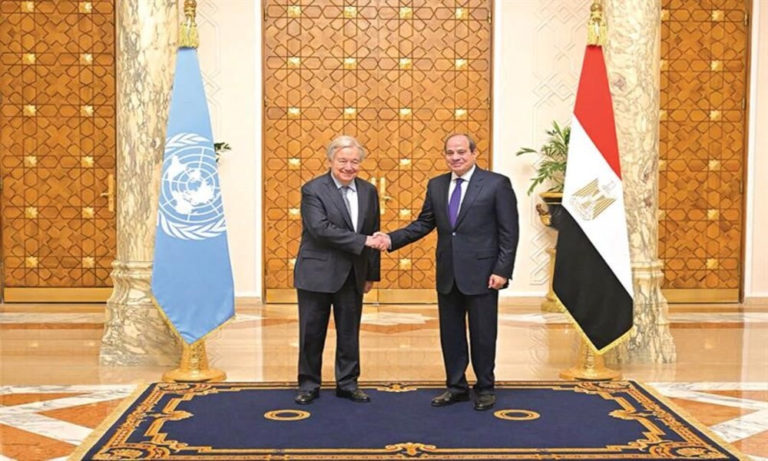
The UN Secretary-General António Guterres has called for diplomatic channels to be kept open amid tensions over Iran, while condemning the deteriorating situation in the Palestinian territories, during a visit to Egypt.
The United Nations Secretary-General, António Guterres, has warned of the risk of a military escalation in the Middle East during a visit to Egypt dominated by tensions between Iran, the United States and Israel.
Received by President Abdel Fattah al-Sisi and Egyptian Foreign Minister Badr Abdelatty, he backed Cairo’s efforts to de-escalate the situation and urged regional and international actors to prioritise diplomatic solutions.
The talks focused in particular on the risk of renewed hostilities against Iran and the consequences such a scenario could have for Gulf countries.
Egypt’s foreign minister said that Egypt was maintaining contacts with Iran and the USA and several regional partners to prevent a fresh confrontation.
Guterres welcomed the initiative, saying that keeping dialogue open was essential amid mounting tensions and displays of force.
The secretary-general’s warning was unequivocal: a large-scale attack on Iran, followed by massive retaliation against Gulf states, could trigger consequences that would be difficult to contain.
Such a scenario threatens regional stability, strategic infrastructure and relations between Middle Eastern powers.
Mediation efforts are continuing as the capitals concerned seek to avoid a military spiral with potentially global repercussions.
The Palestinian question also featured prominently in the discussions. Guterres reaffirmed his support for a two-state solution and the Palestinian people’s right to self-determination.
He condemned violence in the West Bank, the expansion of settlements and expulsions, while calling for sustained humanitarian access to Gaza.
The Secretary-General also stressed the need to remove obstacles to aid deliveries and ensure that humanitarian organisations, particularly the United Nations Relief and Works Agency for Palestine Refugees (UNRWA), could continue operating.
Egypt, which plays a mediating role in the Palestinian issue and is a major access route for aid destined for Gaza, called for humanitarian operations to resume on a sustained basis.
Cairo also advocates strengthening the multilateral system, which it considers essential to preventing conflicts and upholding international law.
President al-Sisi called in particular for reform of the United Nations Security Council to better reflect the international balance of power and increase Africa’s representation.
With only a few months remaining in his term, Guterres has thus placed his visit under the banner of conflict prevention and the credibility of international institutions.
From tensions over Iran to the Palestinian crisis, the issues discussed in Cairo illustrate the limitations of existing mechanisms for resolving crises.
The UN chief said the proliferation of flashpoints made the resumption of dialogue all the more urgent, as the consequences of another war could extend far beyond the borders of the Middle East.
MK/AK/Sf/lb/gik/APA