



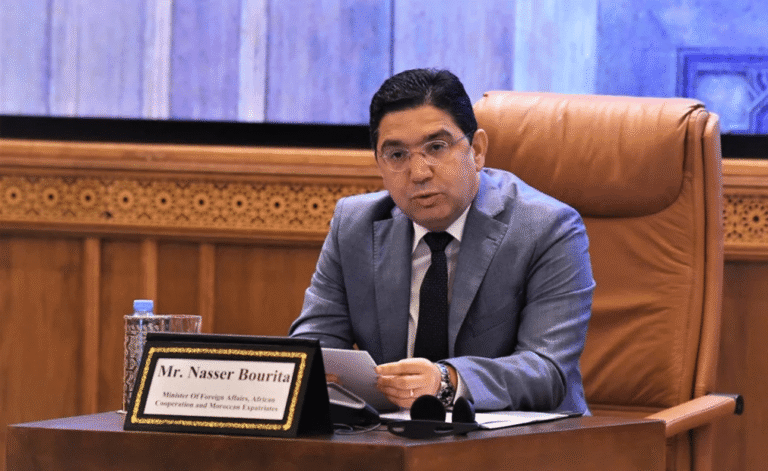
A report by the Middle East Institute for Policy and Economy highlights Morocco’s growing influence in the Sahel through the Atlantic Initiative and the Nigeria–Morocco gas pipeline.
This happens as Algeria faces diplomatic isolation and setbacks in its regional projects.
The report points to a major geopolitical shift in the Sahel, with Morocco consolidating its presence through economic and strategic initiatives, as Algeria, weakened by diplomatic reversals and the loss of regional allies, sees its influence wane.
Niamey’s decision to abandon the Trans-Saharan Gas Pipeline project, which was meant to link Nigeria to Europe via Algeria, is described as a turning point. The withdrawal of Niger’s support further undermined the project, clearing the way for Morocco’s competing venture: the Nigeria–Morocco gas pipeline.
Stretching 5,600 km and designed to carry up to 30 billion cubic meters of gas annually across 15 countries, the pipeline positions Rabat as a central player in regional and European energy security.
Beyond energy, Morocco launched the “Atlantic Initiative” in December 2023, offering landlocked Sahelian states — Niger, Mali, Burkina Faso, and Chad — strategic access to the ocean through Moroccan port infrastructure. Mauritania has already joined the initiative, strengthening Rabat’s profile as an indispensable logistics and trade partner.
Algeria, by contrast, has faced mounting setbacks. The destruction of a Malian drone by its army in April prompted Niger, Mali, and Burkina Faso to recall their ambassadors, while the Sahel Alliance condemned the incident as an “act of aggression.”
Mali later withdrew from the Joint Operational Staff Committee (CEMOC), a security body led by Algiers. In September, Bamako escalated tensions by accusing Algeria of “supporting terrorism” at the UN Security Council.
Both Niger and Mali have since closed their airspace to Algerian aircraft, underlining the rift.
Algeria’s diplomatic decline is also matched by a loss of strategic leverage. In 2024, Mali renounced the 2015 Algiers peace accord with Tuareg groups, stripping Algeria of its long-standing role as a mediator. Despite efforts to reinforce ties with Mauritania, Algiers struggles to compete with Morocco’s assertive diplomacy and the rising footprint of other powers such as Russia and Turkey, which are supplying drones and military technology to Sahel states.
According to the report, Algeria’s approach, rooted in political dialogue, appears increasingly out of step with Sahelian regimes that now favour military solutions. Morocco, by contrast, is leveraging a pragmatic strategy centered on economic integration and energy and maritime corridors, thereby consolidating its regional standing.
MK/ac/lb/as/APA