



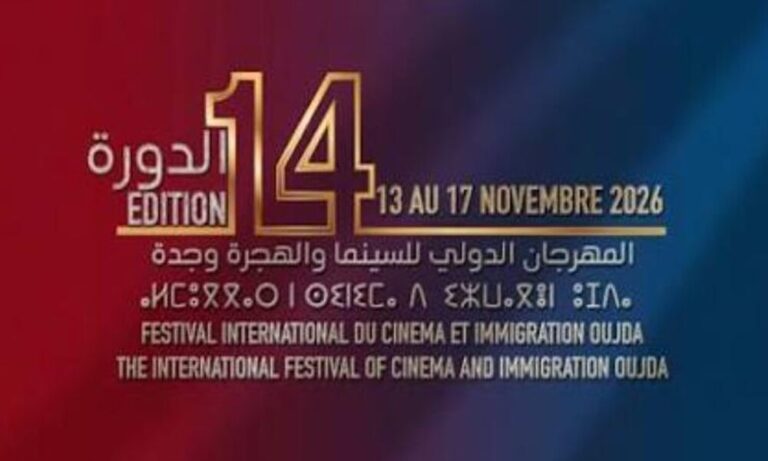
Under the resonant theme “Cinema: A Bridge for Coexistence and a Message of Tolerance,” the 14th edition of the International Festival of Cinema and Immigration officially commenced on Saturday evening at the Mohammed VI Theatre in Oujda.
Organized by the Association for Solidarity, Development, and Immigration and running through November 17, the opening night drew a vibrant crowd of filmmakers, producers, artists, and cinema enthusiasts. This year’s showcase features a diverse slate of cinematic works representing Morocco, France, the Netherlands, the United Kingdom, Egypt, Ivory Coast, Georgia, Germany, Tunisia, and Sweden, with ten feature films and six short fiction entries competing across the festival’s official categories.
In his opening address, festival director and association president Abdellatif Drifi underscored the event’s core mission to strengthen emotional and cultural bonds between Moroccans living abroad and their homeland. He framed the festival as an essential artistic platform designed to spotlight the realities of immigration while cultivating cross-cultural dialogue and bolstering national cinema. Beyond the screenings, the week-long program places a strong emphasis on education and industry development, featuring a dedicated academic symposium for students and migrants, alongside a high-level roundtable exploring the current landscape and future trajectories of Moroccan-European film co-productions.
The inaugural evening also celebrated veteran talent, honoring prominent Moroccan actresses Bouchra Ahrich, Jihane Khalil, and Khouloud Bettioui for their enduring contributions to national theater and cinema. The competitive segments will be rigorously evaluated by an international jury chaired by French director and screenwriter Olivier Gross, alongside Moroccan filmmaker Karim Chafi, Egyptian screenwriter and actor Eslam Mohamed Hafez Marzouk, French director Joël Pellegrini, and Tunisian sound and image engineer Latifa Ben Aicha.
Supported by the Regional Directorate of Culture for the Oriental region, the Wilaya of the Oriental region, the Moroccan Cinematographic Centre, and the Oriental Development Agency, the festival extends its impact beyond the theater through immersive training workshops in film-related professions for young people and migrants, specialized masterclasses for students, and tailored screenings aimed at cultivating younger audiences.
AK/fss/abj/APA