



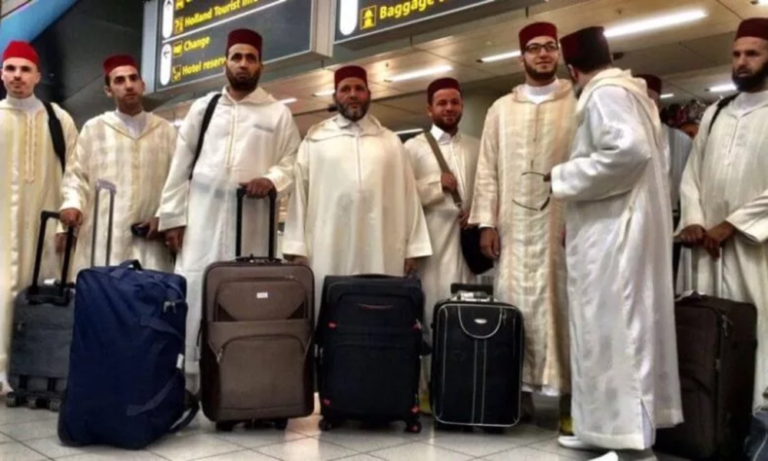
Starting in mid-February, Morocco will deploy 320 religious scholars to Moroccan communities abroad for Ramadan 2026, an annual initiative with significant religious, social, and diplomatic implications.
The Hassan II Foundation for Moroccans Living Abroad announced that the kingdom will send 320 religious scholars to support Moroccans in the diaspora during Ramadan 2026, continuing a tradition which was introduced in 1992.
The delegation will depart Morocco on February 16 to provide religious and spiritual guidance throughout the holy month.
According to the foundation, this mission is structured around diverse academic and religious profiles. It includes 39 university professors, 50 preachers with doctorates, 60 preachers with master’s degrees, and 75 with bachelor’s degrees.
In addition, there are 66 preachers responsible for delivering sermons and leading the Tarawih prayers, as well as 30 imams dedicated exclusively to leading these nightly prayers.
The geographical distribution reflects the importance given to Western Europe.
France will host the largest delegation with 82 scholars, followed by Germany and Spain with 51 each. Belgium will receive 42 delegates, the Netherlands 35, Italy 26, Canada 14, and the United
States 6. Nordic and Central European countries will each host one or a few representatives.
The foundation emphasises that this annual mission aims to promote Morocco’s religious constants – based on the Maliki rite, the Ash’ari doctrine, and Sunni Sufism – while disseminating messages of peace, solidarity, and social cohesion, in accordance with the principles of coexistence.
She also emphasises the symbolic dimension of this support for Moroccans abroad, particularly in Western societies where identity and religious issues are sensitive.
Beyond its religion, this initiative is part of a long-standing and structured religious diplomacy pursued by the kingdom. Often analyzed from an African perspective, notably through the training of imams and South-South cooperation, this diplomacy is also exercised in Europe, where Rabat seeks to stabilise religious practice and counter radicalised rhetoric.
This approach has been reinforced under the reign of King Mohammed VI, making the religious guidance of the diaspora an instrument of soft power and a lever of geopolitical credibility, positioning Morocco as a key interlocutor on the management of Islam in Europe.
MK/AK/fss/as/APA