



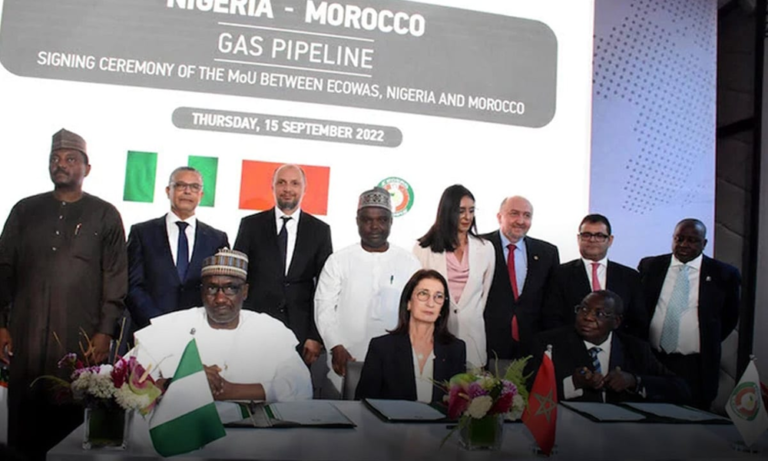
Morocco and Nigeria are moving toward the signing of an intergovernmental agreement to advance the Atlantic Africa gas pipeline, a major energy project spanning approximately 6,900 kilometers.
Jointly spearheaded by Rabat and Abuja, the project has reached a new milestone after nearly a decade of preparation. The Director General of Morocco’s National Office of Hydrocarbons and Mines (ONHYM), Amina Benkhadra, told Reuters that an intergovernmental agreement is expected to be signed within the year.
Estimated at around $25 billion (nearly €23 billion), the infrastructure will connect Nigeria to Morocco via several West African countries, combining offshore and onshore segments.
Following the completion of technical studies, Benkhadra noted that the project will be implemented progressively. “The project does not rely on a single final investment decision,” she said, adding that “each segment is designed as a standalone system, allowing for early value generation.”
This phased approach is intended to accelerate the rollout of initial sections while mitigating the financial risks associated with such a large-scale undertaking.
The initiative also includes the establishment of a dedicated institutional framework. The forthcoming agreement provides for the creation of a high-level pipeline authority, to be based in Nigeria, bringing together ministerial representatives from the 13 participating countries.
In parallel, a project company will be set up in Morocco as a joint venture between ONHYM and the Nigerian National Petroleum Company (NNPC), responsible for overseeing execution, financing, and construction.
From an energy standpoint, the pipeline is expected to reach a maximum capacity of 30 billion cubic meters per year, with around 15 billion earmarked for Morocco and exports to Europe. The route will be developed progressively, linking several regional hubs, including Morocco, Mauritania, and Senegal, as well as a Ghana–Côte d’Ivoire axis before connecting to Nigerian gas fields.
Initial deliveries are projected by 2031.
The project forms part of a broader strategy for continental energy integration, with expected benefits for electricity generation, industrialisation, and mining development across West Africa. Leveraging its geographic position and infrastructure, Morocco aims to position itself as an energy corridor linking African resources to European markets.
MK/AK/Sf/lb/as/APA