





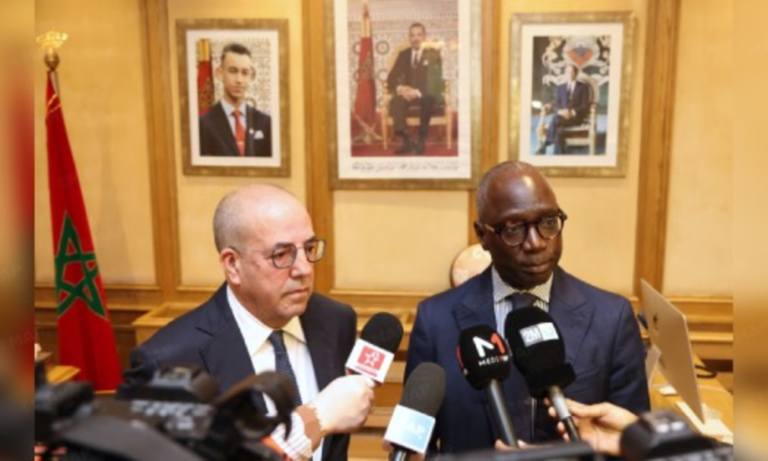
Morocco has established itself as a model to follow in the fields of agriculture and agro-industry, Senegal’s Minister of Agriculture, Food Sovereignty and Livestock, Mabouba Diagne, said Monday in Rabat.
Diagne was emerging from talks with his Moroccan counterpart, Ahmed El Bouari on the sidelines of the 15th Morocco–Senegal Joint High Commission, according to an official statement.
Speaking to the press, Mr. Diagne praised the kingdom’s achievements in agriculture, livestock, horticulture and agro-industry, highlighting the structuring of agricultural value chains and the upstream–downstream integration of production sectors.
“Morocco stands out as a reference model, and its successful experience represents a valuable source of cooperation and knowledge-sharing,” he said, underscoring the strategic importance of this expertise for Senegal.
The Senegalese minister noted that his country imports more than 1.6 billion dollars’ worth of food products annually—around 1.5 billion euros—a level he described as a major opportunity for economic partnership. These needs, he said, open up concrete prospects for joint investment, particularly in agro-industrial processing, the promotion of local production, and the development of storage and distribution capacities.
In this context, Mr. Diagne called on the Moroccan private sector to invest in Senegal, pointing to the availability of water resources and vast areas of arable land. He also stressed the importance of close partnerships with Senegalese private operators in order to build a national production base capable of strengthening food security and improving the well-being of the population.
The presence of Moroccan banking groups in Senegal, he added, represents a key lever for financing and supporting industrial players and project developers.
For his part, Mr. El Bouari reaffirmed Morocco’s commitment to supporting Senegal’s agricultural development, expressing the kingdom’s willingness to share its know-how, particularly in the organisation of value chains, irrigation, mechanisation and agro-industrial upgrading.
“In a spirit of partnership and complementarity, the two countries can jointly develop their agricultural sectors,” he said.
The meeting forms part of a broader bilateral momentum aimed at strengthening sectoral cooperation through structuring projects, with the 15th Joint High Commission serving as a key coordination framework for deepening economic and technical exchanges between Rabat and Dakar.
MK/ak/sf/lb/as/APA