



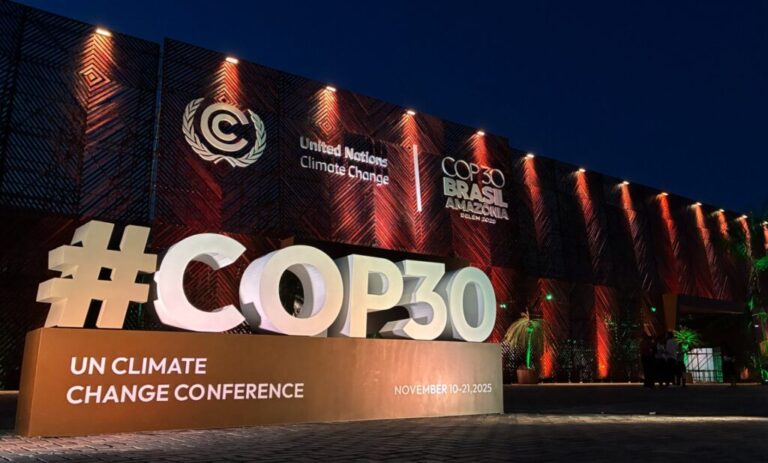
Morocco presented its innovative climate education model, centered on youth participation, at COP30 in Brazil on Saturday.
The Moroccan delegation emphasized that this approach is central to implementing its national low-carbon transition strategy and contributes to structuring a green innovation ecosystem across the African continent.
The presentation took place during a seminar dedicated to educational challenges in the fight against climate change.
According to the Moroccan delegation, environmental education is a key pillar of its updated Nationally Determined Contribution (NDC). The strategy specifically focuses on the direct involvement of young people in defining and monitoring the country’s climate priorities.
The Hassan II International Center for Environmental Training, part of the Mohammed VI Foundation for Environmental Protection, detailed its citizen participation program, which extends across all twelve regions of the country.
Ayman Cherkaoui, the center’s director, explained that climate education has become a “structuring element” of national environmental policies. His institution collaborates with both the public and private sectors, covering education from early childhood through higher education, to promote a climate culture focused on oceans, biodiversity, and adaptation.
Cherkaoui noted that consultations with young people are now integrated directly into the governance of NDCs, ensuring a clear link between public actions and citizens’ expectations.
Morocco also highlighted its African Youth Climate Hub, an initiative launched in 2019 to support entrepreneurs aged 18 to 35. The Hub has already backed some thirty projects across three phases and is planning a new phase focused on strengthening the capacities of young Africans in developing climate solutions.
The delegation asserted that this mechanism is crucial for structuring a green innovation ecosystem on a continental scale.
The session also served as a platform for sharing international best practices. Sara González, Vice-President of COP30 for the Dominican Republic, shared that her country has trained over 10,000 teachers and communication professionals, stressing that education is a “common thread” linking mitigation and adaptation efforts. Other delegates called for moving beyond symbolic youth participation and focusing on measurable indicators for evaluating educational results, aligning with Morocco’s goal of accelerating climate action and consolidating its national commitment to carbon neutrality.
MK/ac/Sf/fss/abj/APA