



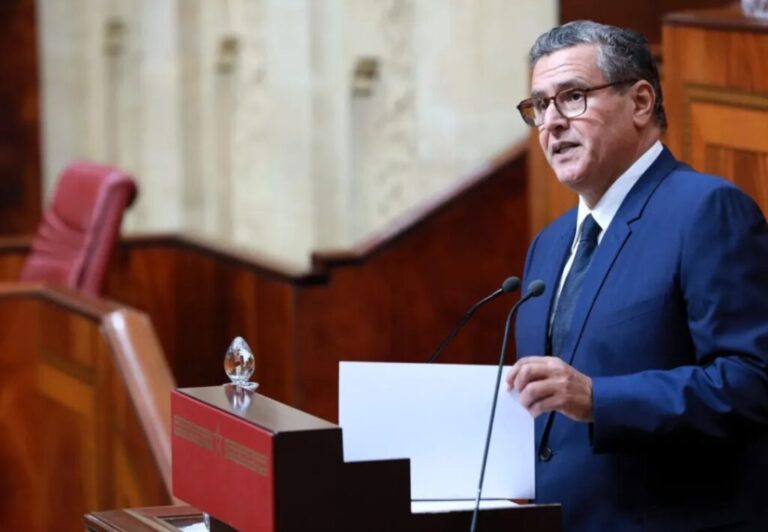
Morocco’s social protection expenditures are projected to reach 39 billion dirhams (approximately $3.9 billion) in 2025, and are expected to surpass 41 billion dirhams ($4.1 billion) in 2026.
In 2024, the Moroccan government dedicated around 32 billion dirhams ($3.2 billion) to social protection spending. Prime Minister Aziz Akhannouch shared these projections on Tuesday during a plenary session at the Chamber of Advisors focused on general policy matters.
Akhannouch emphasised that the government has fulfilled its commitment to expand social protection coverage. The basic mandatory health insurance now covers a broader segment of the population, while the new direct social assistance program supports vulnerable groups.
Moreover, pension schemes have been extended to include more categories of workers.
Authorities also plan to roll out universal unemployment benefits by the end of the year, aiming to enhance job stability and ensure both social and economic security for workers.
The PM described these measures as a deliberate and strategic choice made from the outset of the current administration. He stated that the government’s direction not only addresses national and global challenges but also aligns with the country’s broader ambition to reshape its social model.
Akhannouch framed the initiative as part of an ongoing transformation, granting all Moroccans the right to a decent life and preparing the nation to meet future demands with confidence and resilience.
On health, Akhannouch noted that the government has launched a comprehensive reform to improve the national healthcare system.
Public funding for Morocco’s health sector is expected to reach 32.6 billion dirhams ($3.3 billion) in 2025, up from 19.7 billion dirhams ($2 billion) in 2021.
In education, the government has advanced the 2022-2026 reform roadmap, based on the framework law for education, training, and research.
Akhannouch confirmed that over 85 billion dirhams ($8.6 billion) have been allocated for 2025, with an additional 9.5 billion dirhams ($960 million) to be mobilised annually through 2027.
The Prime Minister also highlighted the activation of the National Charter for Institutionalising Social Dialogue.
This effort has enabled significant wage increases for 4.25 million people, including 1.25 million civil servants and 3 million private-sector employees. The total cost of these raises is expected to exceed 45 billion dirhams ($4.5 billion) by 2026.
Under the new agreement, workers will receive a general salary increase of 1,000 dirhams ($100) per month, implemented in two phases. The government also raised the legal minimum wage, with a 15% increase for non-agricultural sectors and a separate rise for agricultural workers.
MK/ac/sf/lb/as/APA