



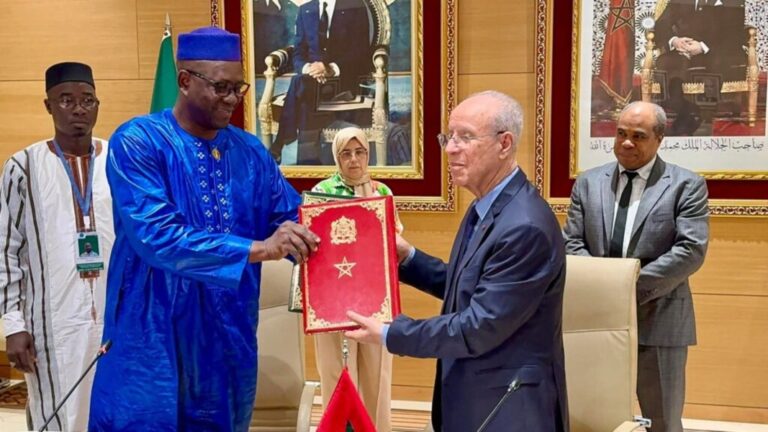
Mali and Morocco have further strengthened their religious cooperation with the signing of a new agreement to train 400 Malian imams in Rabat.
A memorandum of understanding was officially signed on Wednesday, July 9, 2025, in Rabat, providing for the training of 400 Malian imams, mourchidines (male spiritual guides), and mourchidates (female spiritual guides) at the prestigious Mohammed VI Institute for the Training of Imams. The signing ceremony, held at the Moroccan Ministry of Habous and Islamic Affairs, brought together Mali’s Minister of Religious Affairs, Worship, and Customs, Dr. Mahamadou Koné, and his Moroccan counterpart, Dr. Ahmed Taoufiq.
This new protocol expands upon a cooperation initiative that began in 2013, which has already seen approximately 500 Malian imams trained in an initial phase, followed by an additional 300 in 2022. These comprehensive programs are designed to promote an Islam characterized by peace, tolerance, and balance, firmly rooted in the Maliki rite. A key objective is to equip Malian religious leaders with the necessary skills and knowledge to effectively counter extremist ideologies.
The Malian minister, who arrived in Rabat on Tuesday, met with imams currently undergoing training the previous day. He encouraged them to “take full advantage of this opportunity and become role models for their communities,” praising the initiative as “an exemplary partnership.” He emphasized that this cooperation addresses a dual challenge: preserving social cohesion and combating radicalization.
To date, over 800 Malian imams have successfully completed training through this program, with the first class graduating in January 2025. Beyond religious instruction, some beneficiaries have also acquired valuable technical skills in mechanics, carpentry, and refrigeration, facilitating their social integration and enhancing their practical role within their villages and neighborhoods.
Morocco is fully covering all accommodation and training costs for the participants. The curriculum encompasses theology, Maliki jurisprudence, community management, and conflict prevention. This partnership also aligns with Morocco’s broader diplomatic strategy, led by the Mohammed VI Foundation of African Ulemas, which has maintained a presence in Mali since 2015.
Through this renewed program, both Mali and Morocco reaffirm their shared commitment to leveraging faith as a crucial tool for stability and reconstruction, particularly within the fragile Sahelian context.
MD/ac/Sf/fss/abj/APA