





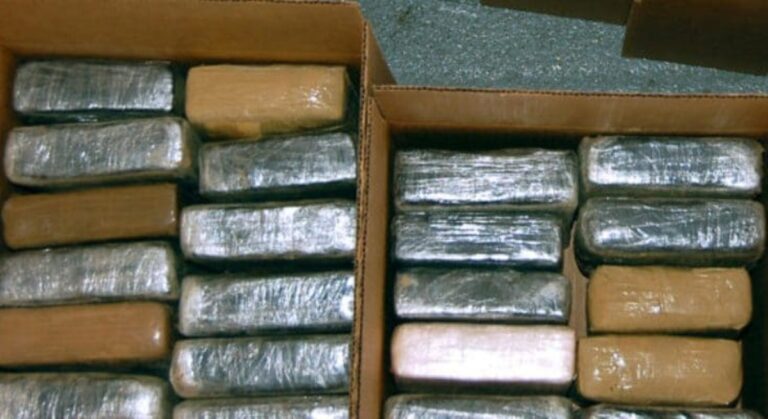
A new report has found that criminal groups from the Western Balkans are increasingly using West Africa as a key hub for trafficking cocaine into Europe.
The report, titled “Under the Radar: Western Balkans’ Cocaine Operations in West Africa,” warns that the region’s ports and weak infrastructure are being exploited by these networks.
The study, published in September 2025 by the Global Initiative Against Transnational Organized Crime (GI-TOC), reveals that Balkan crime groups, including the Montenegrin Kavač and Škaljari clans and Albanian-speaking networks, are using West Africa to store, repackage, and redistribute cocaine.
This shift began around 2019, driven by a surge in drug production in Latin America and increased pressure on direct trafficking routes to Europe. The report suggests that by 2030, up to 50% of Europe’s cocaine could be routed through West Africa.
Ports in Senegal, Guinea-Bissau, and Sierra Leone are identified as major transit points. The Port of Dakar is highlighted as the most strategic hub for exports to Spain and other European countries.
The report also notes that these groups partner with local contacts for logistics, storage, and protection, but the physical presence of Balkan nationals in the region is expected to grow. The Brazilian criminal organization PCC plays a crucial role in supplying the drugs, while Dubai serves as a safe haven for fugitives and a center for money laundering.
The GI-TOC report also warns that local cocaine and crack consumption is on the rise in West Africa, with prices falling in countries like Guinea-Bissau. It also points to the vulnerability of the region’s ports and the use of general aviation for trafficking, a method that is not well monitored.
To combat this growing threat, the report recommends stronger international cooperation, better intelligence gathering, and a focus on disrupting the financial networks and brokers linked to these Balkan groups.
AC/Sf/fss/abj/APA