





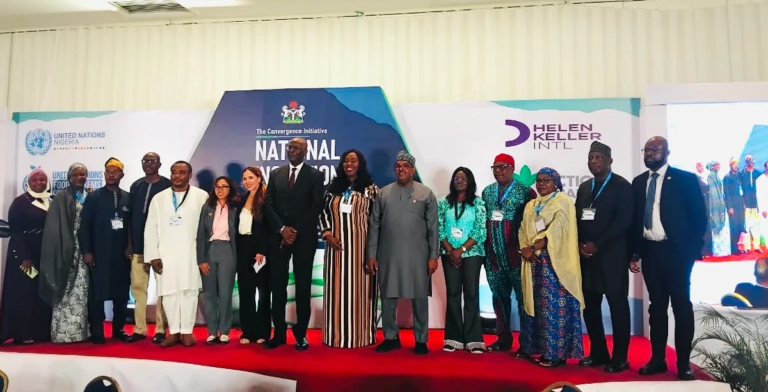
Nigeria has joined 21 other countries in the Convergence Initiative to integrate food systems transformation with climate action as part of efforts to strengthen food security and address climate challenges.
Speaking at the two-day National Dialogue on Nigeria’s Convergence Initiative in Abuja on Wednesday, Nigeria’s Minister of State for Budget and Economic Planning, Dr. Doris Uzoka-Anite, said that the initiative aligned with the National Development Plan (NDP) 2026–2030, which identified food security and climate resilience as strategic priorities.
Uzoka-Anite said that Nigeria’s participation in the initiative would promote evidence-based interventions, strengthen collaboration and ensure locally adaptable solutions for sustainable food systems.
“Nigeria is one of the countries selected to implement this initiative. It is built on a deliberate science-policy-society interface, ensuring that our interventions are evidence-informed, socially legitimate, economically viable and locally adaptable.
“It is about building a nation where no Nigerian goes to bed hungry, where farmers thrive, communities are resilient to climate shocks, and economic growth translates to shared prosperity,” she said.
The minister said that Nigeria was facing the dual challenge of feeding a population projected to exceed 250 million by 2030 while adapting to climate impacts already affecting economic activities.
She said coordinated action, evidence-based interventions and shared accountability had enabled the country to make progress towards building food systems that were inclusive, equitable and capable of delivering improved nutrition, environmental sustainability and better livelihoods.
In his remarks, Nigeria’s Minister of State for Agriculture and Food Security, Dr. Aliyu Abdullahi, said that sustainable food systems could not be achieved without climate-smart approaches.
Abdullahi said that effective climate action should also consider the transformation of the systems through which food was produced, processed and consumed.
He commended the Federal Ministries of Agriculture and Food Security, Environment, and Budget and Economic Planning, alongside the UN Resident Coordinator’s Office, UN Food Systems Hub, National Food Systems Convenor and development partners for convening the dialogue.
“The Federal Government recognises that transforming Nigeria’s agrifood systems is one of the most powerful pathways for accelerating economic growth and achieving food security.
“With more than 40 million agricultural households participating in the sector and agrifood systems contributing nearly 40 per cent of GDP, investments in agriculture generate far-reaching impacts across employment, trade, nutrition and environmental sustainability,” he said.
The Permanent Secretary, Federal Ministry of Budget and Economic Planning, Mrs. Deborah Odoh, said that climate-resilient food systems were critical to Nigeria’s sustainable economic growth.
Odoh said that agricultural policies should integrate climate adaptation measures to strengthen resilience and reduce food inflation.
“Food is not merely a household necessity; it is the bedrock of national security, public health and industrial stability,” she said.
She said that Nigeria could no longer design agricultural policies in isolation from climate realities, noting that shifting weather patterns, prolonged droughts and flooding were disrupting supply chains and contributing to food inflation.
According to her, restructuring how food is produced, processed and distributed is essential to achieving the objectives of the Medium-Term National Development Plan (MTNDP) 2026–2030 and Nigeria Agenda 2050.
Earlier, Deputy Director, UN Food Systems Coordination Hub, Lara Blancho Rothe, said that Nigeria’s participation marked an important step towards strengthening collaboration between food systems transformation and climate action.
Accordng to Rothe, countries globally are recognising the need to address food systems and climate challenges together, as climate change continued to affect food production, livelihoods and nutrition.
She said that Nigeria had demonstrated commitment to transforming its food systems since the 2021 UN Food Systems Summit, with over 40 national and local dialogues contributing to the development of the country’s Food Systems Transformation Pathway and 78 priority actions.
She reaffirmed the UN Food Systems Coordination Hub’s commitment to supporting Nigeria’s food systems transformation through continued collaboration with government, the UN Country Team and other stakeholders.
The dialogue had the theme: “Bringing together stakeholders to advance the alignment between food systems transformation and climate action, empowering national efforts to achieve the SDGs and Paris Climate Agreement targets.”
According to local media reports, the Convergence Initiative seeks to align food systems transformation with climate action by maximising synergies between both agendas and contributing to the achievement of the SDGs and Paris Climate Agreement targets.
GIK/APA