





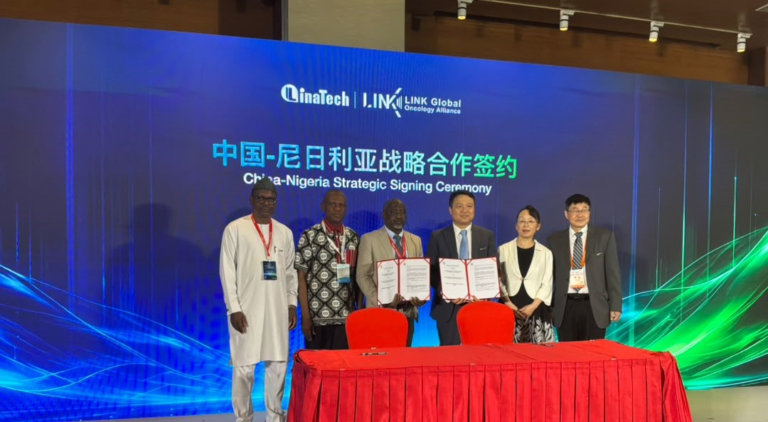
Nigeria’s Minister of State for Health and Social Welfare, Dr Iziaq Salako, says that Nigeria is targeting technology transfer and local production of radiotherapy and imaging equipment by 2030 to strengthen cancer care.
Dr Salako said in a statement on Saturday after the Link Global Summit on Innovation and Practice in Oncology in Beijing, China, that Nigeria was seeking stronger partnerships to translate oncology innovations into practical solutions that could reach more patients.
“Looking to 2030, our ambitions are larger. We want technology transfer and the local assembly and servicing of radiotherapy and imaging equipment in Nigeria,” he said.
He said that the Nigerian Government’s zero-duty and zero-VAT incentives for health manufacturing would support efforts to build domestic capacity.
Salako called for joint clinical trials and registry-linked research to improve understanding of cancer phenotypes affecting African populations.
He said that Nigeria also wanted Artificial Intelligence-assisted treatment planning, adaptive radiotherapy and tele-oncology links between Chinese and Nigerian cancer centres.
The minister stressed that technology introduced into Nigeria must come with training and maintenance systems to ensure sustainable use and improved patient outcomes.
“Machines without people are monuments,” Salako said, stressing the need for trained personnel, in-country servicing and spare-parts arrangements.
He said that Nigeria wanted its cancer centres of excellence, the National Institute for Cancer Research and Treatment (NICRAT) and tertiary hospitals twinned with Chinese cancer hospitals.
Salako said that the Radiotherapy Working Group of the China-Africa Hospital Alliance should establish a clinical training base in Nigeria to serve as a West African hub for advanced radiotherapy training.
He explained that the base would also create a fellowship pipeline with Chinese institutions for radiation oncologists, medical physicists, radiotherapy technologists and biomedical engineers.
Salako said that Nigeria’s partnership with China also covered radiotherapy technical support, joint research and development and structured academic exchanges.
“The Memorandum of Understanding we sign today commits to radiotherapy technical support, joint research and development, to structure China-Nigeria academic exchange, and to help Nigeria establish the professional bodies that will govern radiotherapy practice for a generation.
“Nigeria seeks key strategic outcomes in the months ahead: a joint work plan with named focal persons and quarterly milestones, so that this Memorandum lives beyond the signatures,” he said.
He said that Nigeria’s cancer-control ambitions were anchored in the Nigeria National Cancer Control Plan 2026–2030, which prioritised prevention, decentralised diagnostics, radiotherapy and other treatment options across the geopolitical zones.
He said the government was also strengthening financial risk protection, developing the oncology workforce and building national clinical trial and cancer registry ecosystems.
According to Salako, Nigeria aims to build capacity to install, service and eventually produce cancer technologies, positioning the country as a contributor to global cancer care.
He said Nigeria recorded an estimated 127,763 new cancer cases and 79,542 deaths in 2022, but its mortality-to-incidence ratio improved from 62.3 per cent in 2022 to 59.6 per cent in 2024.
On treatment access, Salako said that the National Cancer Access Programme, Catastrophic Health Insurance Scheme and National Cancer Health Fund were supporting essential cancer care.
He added that the Social Determinants of Cancer Care Fund was helping to improve affordability and reduce financial uncertainty for patients and families.
GIK/APA