





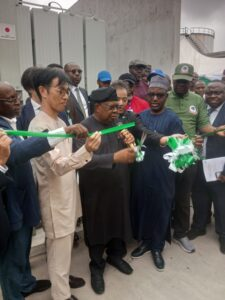
Nigeria’s Minister of Power, Mr Joseph Tegbe, says that the Nigerian Government has added 208 megawatts (MW) to bulk electricity transmission capacity in Lagos.
Inaugurating the 2×60MVA, 132/33kV Gas Insulated Substation (GIS) at Apapa and two 100MVA, 132/33kV power transformers at Ijora to upgrad the facilities at the substations in Lagos on Monday, Tegbe said that the projects would strengthen electricity supply to some of Lagos’ most economically important corridors, supporting port operations, manufacturing, logistics, commercial activities and millions of consumers.
The minister said that the project was more than an engineering achievement, adding that it was an investment in one of the nation’s most economically consequential corridors.
“Apapa is not an ordinary electricity load centre. It is one of the commanding heights of the Nigerian economy,” he said.
Tegbe explained that the Apapa corridor hosts port operations, maritime services, logistics companies, manufacturing facilities, warehouses, commercial enterprises and supporting industries whose activities extend beyond Lagos.
He said that the upgraded Apapa facility had increased bulk power availability in the axis by about 96MW.
According to him, the project comprises a modern GIS equipped with two 60MVA, 132/33kV power transformers, new 132kV and 33kV GIS switchgear and a control building.
At Ijora, the minister said that the installation of two new 100MVA transformers had increased the substation’s total installed capacity from 90MVA to 230MVA, translating to an additional 112MW of bulk transmission capacity.
He said that the upgrade would improve electricity supply to Ijora, Costain, Oyingbo, Customs and adjoining communities, while supporting commercial activities and consumers within the Eko Electricity Distribution Company (EKEDC) franchise area.
Tegbe said that the previous Ijora substation was equipped with three 30MVA transformers, providing a total installed capacity of 90MVA, equivalent to about 72MW.
He said the rising population, commercial activity and industrial expansion had outgrown the capacity, resulting in suppressed load and constrained electricity supply.
“The consequence was what we have come to know all too well in our electricity sector: suppressed load, constrained supply and businesses having to operate below their potential,” he said.
Tegbe said the Federal Government was committed to investing in the transmission network, removing bottlenecks, strengthening critical substations and creating the capacity required to evacuate and deliver electricity generated across the country.
“The projects being inaugurated today are a practical demonstration of that commitment and a testament that this administration’s power sector investments are deliberate, technically sound and closely aligned with economic demands,” he added.
GIK/APA