





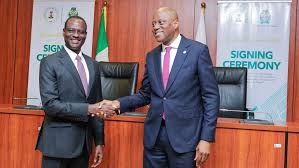
Nigeria’s Federal Ministry of Finance and the Central Bank of Nigeria (CBN) have signed a Memorandum of Understanding (MoU) to strengthen fiscal and monetary policy coordination.
According to the statement by the Head, Information and Public Relations Unit of the Ministry, Efe Ovuakporie, on Friday in Abuja, the framework seeks to improve economic stability, policy consistency and coordinated efforts to address inflation.
Nigeria’s Finance Minister and Coordinating Minister of the Economy, Mr. Taiwo Oyedele, said at the signing that the MoU would institutionalise closer coordination between both institutions.
He said that the framework would strengthen information sharing, align macroeconomic assumptions and forecasts and provide mechanisms for resolving conflicting policy actions.
Oyedele said that the arrangement would move coordination beyond personalities and make it a permanent feature of Nigeria’s economic management.
According to the minister, the two institutions must retain their distinct mandates and independence while recognising their policies’ impact on the same economy.
The minister said that government borrowing affected liquidity, interest rates and financing costs, while monetary policy also had implications for government finances.
Oyedele explained that exchange rates, tariffs, government spending and agricultural policies directly affected prices, revenue and economic activities.
He identified bringing inflation sustainably into single digits as a major focus of the framework and that achieving the target required disciplined spending, sound liquidity management and efficient government financing, alongside measures addressing structural inflation drivers.
Oyedele disclosed that on food inflation, the ministry would work with relevant institutions and states to strengthen grain reserves and improve agricultural yields.
He said that irrigation, climate resilience and farm-to-market infrastructure would also receive attention.
The minister ruled out a return to fuel subsidy, saying that it would increase pressure on public finances and the naira, while improved foreign exchange stability and fuel tax exemptions had contributed to moderating prices.
The minister said that under the framework, both institutions would share information on cash positions, financing plans, credit growth and foreign exchange flows.
“Better coordination starts with a common evidence base,” Oyedele added.
In his speech, the CBN Governor, Mr. Olayemi Cardoso, described the signing as a significant step towards strengthening Nigeria’s macroeconomic management and economic stability.
Cardoso said that the fiscal and monetary policies were complementary instruments whose combined impact was stronger when implemented harmoniously.
According to him, the MoU formalised longstanding collaboration between both institutions through structured consultation, information exchange and policy coordination.
He noted that cooperation will cover government cash management, debt issuance planning, liquidity forecasting and macroeconomic analysis.
Cardoso explained that the timing was important as the CBN advances its transition towards an inflation-targeting framework.
He said that the effectiveness of the framework would depend partly on a supportive fiscal environment.
Cardoso commended the minister and the technical teams for bringing the initiative to fruition, while reaffirming the CBN’s commitment to sound monetary policy, macroeconomic stability and financial system resilience.
GIK/APA