



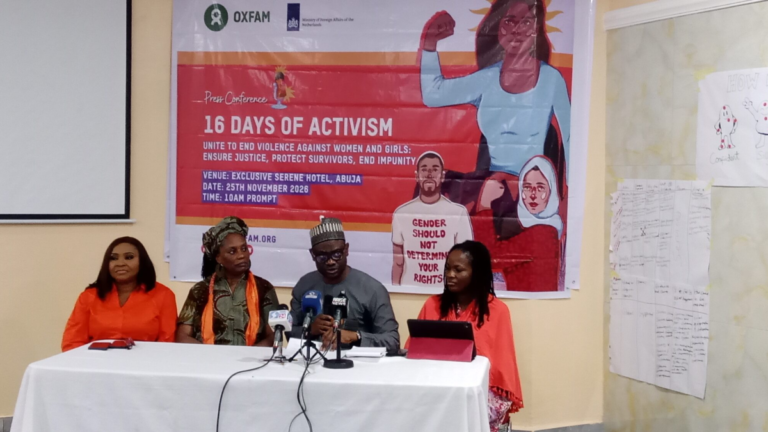
The Oxfam Country Director for Nigeria, Tijani Hamza, has unveiled a five-year 6.4 million euro programme, (FemFocus) to address violence against women and girls and strengthen protection for women human rights defenders in Nigeria.
Speaking at the launch of the programme on Wednesday in Abuja, Hamza, disclosed that the programme would run from 2026 to 2030.
According to him, the launch coincided with the International Day for the Elimination of Violence against Women and the commencement of the 16 Days of Activism Against Gender-Based Violence, observed from Nov. 25 to Dec. 10.
Hamza stated that the campaign aligned with the 2026 global UNITE campaign theme: “UNITE to End Violence Against Women and Girls: Ensure Justice, Protect Survivors, End Impunity.”
He explained that FemFocus was funded by the Ministry of Foreign Affairs of the Netherlands and implemented in 12 countries, including five in West Africa and seven in Southwest Asia and North Africa.
According to him, out of Oxfam’s €140 million global programme portfolio, €38 million is allocated to West Africa, while €6.4 million is earmarked for Nigeria.
He said that the programme would pursue four major objectives: preventing violence against women and girls, expanding access to survivor-centred services, strengthening laws and institutional accountability, and protecting women human rights defenders.
Hamza said that Oxfam would implement the programme in partnership with the Netherlands Ministry of Foreign Affairs, the Embassy of the Kingdom of the Netherlands, women’s rights organisations and feminist movements.
He added that the initiative would also engage frontline service providers and public institutions to move decision-making power and resources closer to grassroots actors.
“A strategy designed without the voices of frontline actors will never succeed.
“With only three years remaining until 2030, business as usual is not an option,” he said.
Hamza urged the federal and state governments, law enforcement agencies, the judiciary, traditional leaders, the media and the private sector to support survivors and provide resources for grassroots feminist movements.
He said that the programme was being launched at a critical time, given the scale of violence against women and girls in Nigeria.
Citing the 2024 Nigeria Demographic and Health Survey (NDHS), Hamza said that 21 per cent of Nigerian women aged 15 to 49 had experienced physical or sexual violence and that 23.4 per cent had experienced intimate partner violence.
He also cited National Human Rights Commission (NHRC) data, which recorded 84,187 domestic violence complaints in 2024, the highest annual figure since the commission began tracking such cases.
Hamza said that economic abuse, harmful traditional practices and technology-facilitated violence continued to undermine progress, with survivors spending up to N100,000 out of pocket to seek justice.
He added that 245 violations documented in the previous year reflected the threats and intimidation confronting women human rights defenders amid a shrinking civic space.
According to him, Nigeria’s challenge is no longer primarily the absence of laws, but inadequate implementation, financing and infrastructure.
GIK/APA