





In Dakar, National Oyster Day celebrated on January 29th the transformation of a long-standing artisanal sector
into a genuine driver of women’s empowerment and sustainable innovation.
Amidst colourful stalls and official speeches, women oyster processors and young oyster farmers embodied Senegal’s ambition to make this mollusk a symbol of inclusive aquaculture growth.
Under the bright sun of Place du Souvenir Africain in Dakar, the oyster took centre stage on Thursday, January 29, 2026. National Oyster Day was in full swing in a friendly, almost familial atmosphere: laughter, lively conversations in Wolof and French, all against the briny aroma mingling with the scents of oyster powder and artisanal smoke.
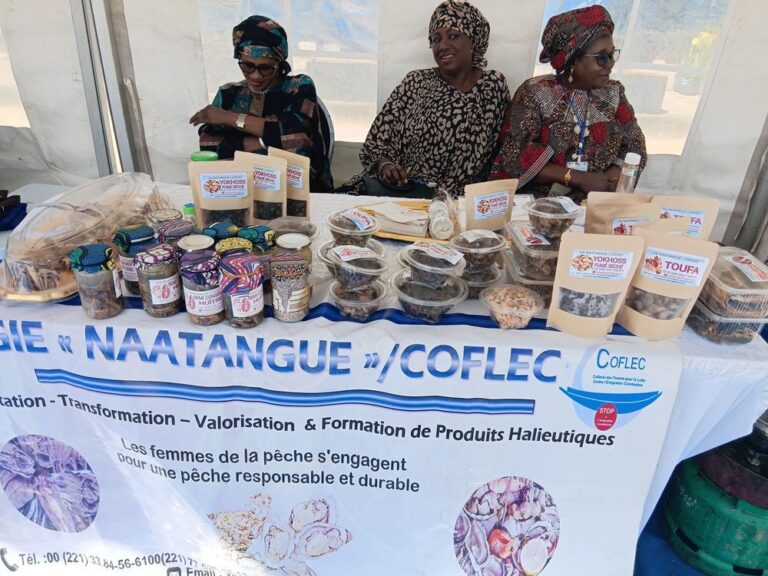
White tents sheltered colourful stalls where women from the Saloum Islands to Casamance, and along the Petite Côte, proudly displayed the fruits of their hard work. Beneath a stall, three women in immaculate traditional boubous, headscarves elegantly tied, watch over a laden table.
Gleaming glass jars hold dried oysters (yokhoss), smoked shrimp, semi-preserved oysters in oil, and blends of briny spices.
Nearby, transparent bags reveal dried shrimp, crushed shellfish, and even fine oyster powder. This last item is a traditional feed supplement, reimagined for laying hens or human consumption. A true festival of flavours and expertise.
A little further on, another stall attracts curious onlookers.
Mountains of oyster shells, crushed into granules, transformed into oyster powder or compact blocks for soil amendment or animal feed, are on display.
“Senegalese oysters are not just a fisheries resource; they are a driver of empowerment, particularly for women, who play a central role in harvesting, processing, and marketing,” declares Dr. Fatou Diouf, Minister of Fisheries and Maritime Economy, who came personally to attest to the strategic importance of this sector.
“Through this sector, thousands of households are increasing their income, improving their living conditions, and gaining economic independence,” she adds.
The Association of Women Producers proudly displays its slogan: Value Addition, Processing, Training. These women are no longer content with simply harvesting; they are innovating, packaging, and marketing.
“This edition is particularly special. With a view to empowering RENACVAH, the National Network of Actors in the Oyster Value Chain, the FAO entrusted it with organising the National Oyster Day,” emphasises Bintia Stephen Tchicaya, Coordinator of the Sub-Regional Office for West Africa and Acting FAO Representative in Senegal.
She points out that through the matching fund, 28 investment projects have been subsidised to the tune of $300,000, or nearly 170 million CFA francs. Modernised infrastructure in Dakar, Soucouta, and Némaba in
the Saloum Islands testifies to this transformation, she asserts.
And then there are the technical innovators. Under a nearby tent, two young men are presenting modern oyster farming systems: wire mesh cages, cleverly secured collectors made from recycled bottles, and submersible tubes and structures for the Petite Côte and the Somone lagoon.
Brochures are being circulated, and samples of young oysters attached to a substrate are attracting admiring glances. “Thanks to the introduction of sustainable oyster farming techniques, improved processing methods, traceability, and compliance with health regulations, the sector is modernising, becoming more professional,
and conquering new markets,” Minister Diouf says gleefully.
She also emphasises the environmental dimension. According to her, oysters contribute directly to environmental sustainability. They naturally filter water, participate in mangrove restoration, and protect estuarine ecosystems.
“By protecting oysters, we preserve our coasts, our biodiversity, and the future of our communities,” she notes.
Everywhere, the energy is palpable. The oyster, this small, discreet mollusk of Senegal’s mangroves and estuaries, has become a symbol of resilience, women’s empowerment, and a sustainable future for the fishing industry.
“Our ambition is to make the oyster a symbol of inclusive aquaculture growth, a product of national pride, and a model of a sustainable sector in West Africa, particularly in Senegal,” Dr. Fatou Diouf concludes.
ARD/ac/fss/as/APA