



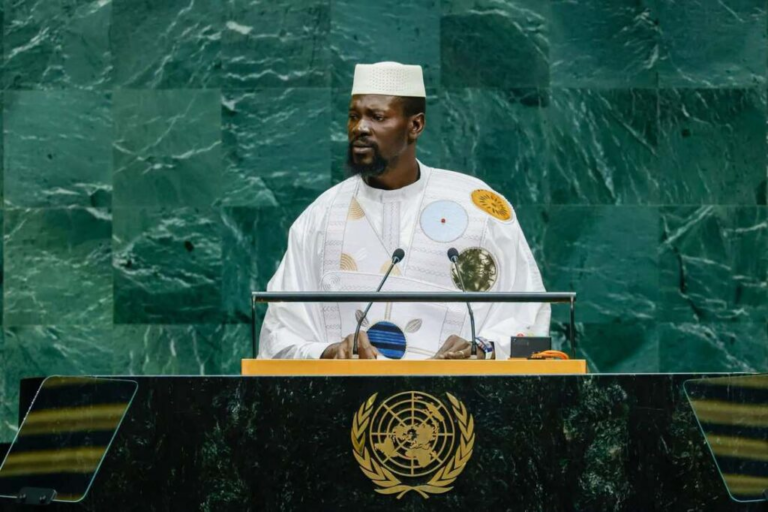
Guinean President Mamadi Doumbouya on Wednesday presented the Simandou 2040 programme at the United Nations as a driver of Guinea’s economic transformation, while defending a development model based on national choices and the use of natural resources to support development.
Addressing the 81st session of the United Nations General Assembly, President Mamadi Doumbouya highlighted achievements he attributed to his government over the past three years, particularly in infrastructure, industry, education and healthcare.
“The Simandou 2040 programme embodies an ambition for the structural transformation of our economy,” Mamadi Doumbouya said, stressing that the strategy should not be limited to mining.
According to the Guinean president, Simandou 2040 is intended to drive development in infrastructure, agriculture, energy, education, healthcare and industry, with a view to promoting broader economic transformation.
Doumbouya also cited the development of the Simandou megaproject, more than 1,000 kilometres of paved roads, the construction of schools and hospitals, as well as several industrial projects aimed at increasing local processing of mineral resources.
He notably referred to three alumina refineries under construction and a gold refinery that he described as the largest in Africa in terms of production capacity.
For Mamadi Doumbouya, the strategy should also help unlock the potential of Guinea’s young population. He cited the Simandou Academy, an initiative aimed at providing training tailored to labour-market needs while promoting employment and entrepreneurship.
The Guinean president also defended the view that African countries should be able to adapt their governance and development models to their own historical, social and cultural realities.
“When governance models are adapted to the historical, social and cultural realities of each nation, rather than imported without discernment, development accelerates,” he said.
Referring to his previous address to the UN three years ago, Mamadi Doumbouya said he now intended to present “some factual elements” about the path chosen by Guinea, rather than limiting his remarks to criticism of existing models.
He notably highlighted the adoption of a new constitution and what he described as the organisation of the entire direct electoral cycle, with funding provided by the Guinean Treasury.
On the international front, the Guinean president called for a renewed partnership between Africa and its partners, based on respect for sovereignty and “win-win co-construction”.
“Africa can also follow this path,” he said, citing the development trajectories of several countries in Asia and the Middle East that have adapted international experiences to their national realities.
Mamadi Doumbouya concluded by assuring the international community that Guinea intends to remain “a reliable, open and committed partner”, in accordance with international law and the Charter of the United Nations.
TE/Sf/lb/as/APA