



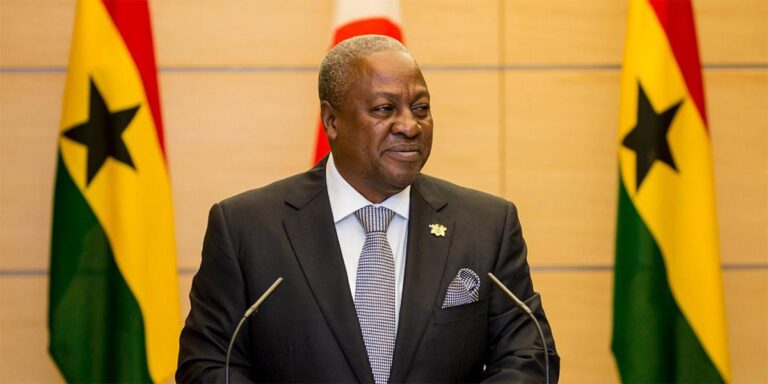
The Ghanaian President John Dramani Mahama has confirmed that Ghana has initiated the process to exit its programme with the International Monetary Fund (IMF), highlighting the economic progress recorded and the restoration of the country’s credibility on the international stage.
In his New Year’s address, President Mahama announced that the country has begun the process of withdrawing from its programme with the International Monetary Fund (IMF), assuring that the transition would be done “with dignity,” as a partner and not as a supplicant.
Reflecting on the situation inherited by his administration, the Ghanaian leader recalled that one year ago, the country was facing “an economy on its knees,” marked by high inflation, massive youth unemployment, loss of public confidence and degraded infrastructure.
However, he stressed that “difficult but necessary” reforms have enabled a significant economic recovery to begin.
According to President Mahama, inflation, which exceeded $23\%$ at the end of 2024, has sharply declined and is expected to hover around $5\%$ by the end of 2025.
He also highlighted the relative stability of the Ghanaian cedi, a resumption of economic growth and a renewed confidence among investors, illustrated by the increase in domestic and foreign direct investments.
It is within this context, he explained, that Ghana has restored its credibility with its international partners and successfully completed the renegotiation of its debt “under conditions that protect national sovereignty, while ensuring sustainability.”
On the strength of these achievements, the country “is beginning the process of exiting the IMF programme with dignity, not as beggars, but as partners,” he insisted.
The Ghanaian President estimated that this step marks a turning point for the Ghanaian economy and paves the way for a new phase focused on job creation, particularly for young people, the consolidation of macroeconomic stability, and the continuation of structural investments.
He reaffirmed his government’s commitment to maintaining prudent management of public finances, which he considers, an essential condition for ensuring sustainable post-IMF growth.
AC/sf/lb/gik/APA