





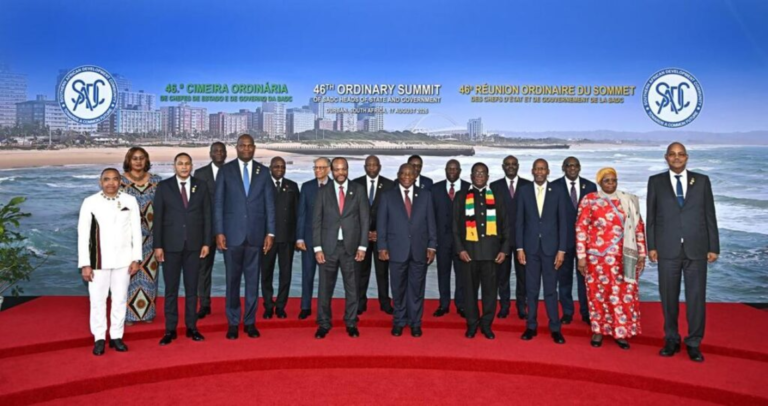
Heads of state and government of the Southern African Development Community (SADC) reaffirmed their commitment on Monday to strengthening regional integration and cooperation in response to security, health, economic and climate challenges across the region.
Meeting at the 46th Ordinary Summit of the regional bloc, held under the chairmanship of South African President Cyril Ramaphosa, SADC leaders renewed their solidarity with the Democratic Republic of the Congo (DRC).
They reiterated their support for regional and international efforts to restore peace, protect civilian populations, and address pressing humanitarian and health needs.
The summit called for coordinated action against the Ebola virus outbreak, particularly in the DRC, where a strain of the Bundibugyo virus is present.
Member states were urged to step up epidemiological surveillance, readiness, and rapid information sharing to prevent and contain potential new outbreaks.
In this regard, SADC commended the financial and technical assistance provided by South Africa, Angola, Zimbabwe, the Africa Centres for Disease Control and Prevention (Africa CDC), the World Health Organization (WHO), and other international partners.
On the security front, leaders emphasised the urgent need to consolidate peace and stability across the region.
They welcomed the national dialogue underway in Mozambique and commended Maputo’s efforts to combat terrorism in key areas of Cabo Delgado province.
Regarding Madagascar, the summit encouraged political stakeholders to maintain relative calm and prioritise dialogue to settle political differences.
SADC reaffirmed its support for ongoing reform processes and a full return to constitutional order.
Addressing economic priorities, heads of state urged member nations to leverage global geopolitical and economic shifts to deepen regional integration, boost trade and investment, and enhance internal resource mobilization.
The summit identified several key priority sectors to accelerate economic transformation, including industrialization, regional value chains, agribusiness, critical minerals, energy transition, economic corridors and cross-border infrastructure.
Leaders also called for expanding regional trade in agricultural products by removing non-tariff barriers, harmonising standards and improving cross-border logistics – aimed at facilitating food supplies from surplus areas to deficit regions while stabilising supply and prices.
Given the climate risks associated with the El Niño phenomenon, member states were urged to strengthen early warning systems, drought preparedness mechanisms and climate-resilient agriculture through expanded irrigation and drought-resistant crop varieties.
To enhance mobility, the summit approved the agreement establishing the SADC Tourism UNIVISA, designed to ease intra-regional travel, boost tourism, deepen integration and attract investment.
The summit adopted as its official theme for the 46th session: “Resilient, sustainable and inclusive industrialisation through infrastructure development, agricultural transformation and critical minerals, in pursuit of a just world.”
At the conclusion of the summit, Cyril Ramaphosa was elected Chairperson of SADC while Zambia was named to assume the incoming chairmanship. The next ordinary summit will take place in Zambia in August 2027.
The 46th SADC Summit comes against a regional backdrop marked by ongoing security and health challenges, balanced by a shared ambition among member states to accelerate economic integration and build resilience against climate shocks and shifting global market dynamics.
TE/Sf/lb/jn/APA