



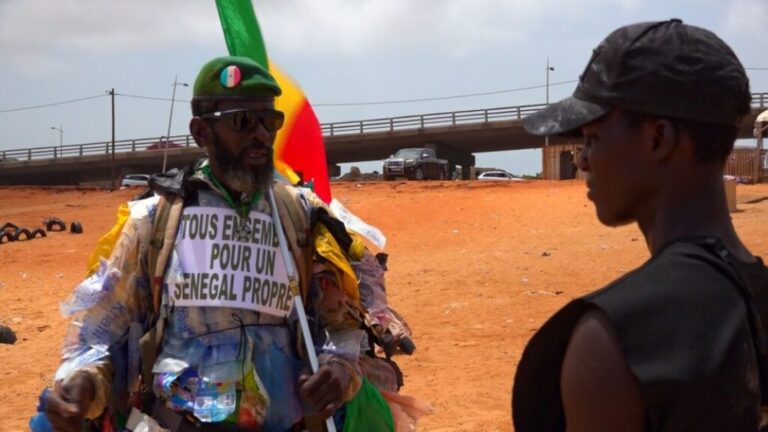
A well-known figure in the Senegalese environmental movement, Modou Fall, also known as “Plastic Man,” is raising the alarm about the accumulation of plastic waste in Dakar, as the capital prepares to host the Youth Olympic Games.
From Malibu Beach, he is advocating for urgent measures to collect, recycle, and reduce waste. Just weeks before the Youth Olympic Games (YOG) kicks of in October, Malibu Beach in Guediawaye presents an unusually calm scene on Thursday morning.
A few members of the National Fire Brigade are keeping watch, while a handful of bathers occupy the shoreline.
But for environmental activist Modou Fall, aka “Plastic Man,” this apparent tranquility should not obscure the urgent need to rid Senegal of plastic pollution.
At noon, under a scorching summer sun, Modou Fall arrives dressed in an outfit made entirely from plastic waste.
His clothing bears a message in large letters: “Together for a Clean Senegal.” With his salt-and-pepper beard, sunglasses, and green beret emblazoned with the Senegalese flag, he also wears the National Order of Merit medal around his neck, awarded to him in August 2016 by former President Macky Sall.
A former soldier, Modou Fall recounts that his environmental commitment was born during his time at the border between Senegal and Mali, where he says he witnessed the degradation of ecosystems, particularly through excessive logging.
“After my military service, I returned to civilian life and thought: why not share the experience I gained in the army with other young people?” he tells APA.
He admits to having started his fight without any particular knowledge of environmental issues. “At first, I knew absolutely nothing about the environment. But it was willpower and commitment that gave me the strength and determination,” says the man who now boasts more than twenty years of fighting against plastic pollution.
“Plastic Man,” a nickname that became an identity
His nickname, which has become inseparable from his public persona, comes from an encounter with the American press. “Plastic Man comes from the Americans, particularly the New York Times, with whom I had the opportunity to do an interview. That’s where the name started,” he says.
Since then, Senegalese people have taken to the name to refer to him. Some even go so far as to call him “Modou Mbous,” the Wolof word for plastic bag.
But behind this colourful character lies a deep concern about the omnipresence of plastic in the environment.
At Malibu Beach, he points to the accumulated waste on the sand. “Look at all this. Here, you can find several brands. If you remove the plastic, there’s almost nothing left,” he says, indicating the discarded packaging and bottles.
For him, the problem goes far beyond just urban cleanliness. Plastic waste ends up in the oceans, is ingested by fish, and can then end up in human food. The same phenomenon, he emphasises, affects livestock when animals swallow discarded plastic bags.
“You use a plastic bag; you throw it away. A sheep or a cow can eat it very quickly. And then we’re the ones who end up eating these products,” he warns.
Dakar, showcase of the Youth Olympic Games
The upcoming arrival of thousands of visitors and young athletes for the Youth Olympic Games, he believes, gives a new dimension to his fight. Modou Fall is calling on authorities to take strong measures before the start of the competition, arguing that the event represents both an additional risk of waste production and a unique opportunity to showcase Senegal’s progress in environmental protection.
“The whole world will be watching Senegal because of the Olympic Games. It’s time for the government to truly regulate the plastics sector,” he pleads.
He is particularly concerned about the proliferation of bottled water and water brands produced under what he considers insufficiently regulated conditions, especially during large religious gatherings like the Magal and the Gamou.
For the activist, the issue is therefore no longer just about access to water, but also about the management of the plastic containers used to distribute it.
He believes that the arrival of sports delegations and spectators could exacerbate the problem. “Imagine such an event with more than 2,700 athletes.” “If each athlete uses five to six bottles a day, imagine the volume of plastic produced, not counting the fans,” he says.
“We need to give plastic a second life.”
Modou Fall also addresses the consequences of current waste management practices. According to him, a large portion of the plastic collected from the streets and beaches is transported to the Mbeubeuss landfill in the Dakar suburbs, where burning it can contribute to air pollution.
“If air pollution increases, it’s our children who will suffer the consequences,” he warns. To avoid this vicious cycle, he calls for stricter regulations on plastic and, above all, the establishment of a genuine recycling and recovery system.
“All the plastic we collect must be able to be taken somewhere where it can be given a second life,” he insists.
The activist is nonetheless optimistic about changing behaviours. He observes a growing desire among Senegalese people to better manage their waste, citing in particular the small personal bags used by some
women and the practice of people keeping their trash in their pockets when no bin is available.
But he points out a major contradiction: “You can walk a kilometre or two in Dakar without finding a single bin in the street. That, too, is a problem.”
For him, changing behaviours must therefore be accompanied by infrastructure and a coherent public policy.
“People want to change. There are many initiatives. But it is the state that must support civil society so that we can put an end to this scourge,” he maintains.
A call to Youth Olympic Games advocates
As the Youth Olympic Games approach, Plastic Man also wants to mobilise young people. “If a participant in the Games says that Senegal is dirty, it doesn’t just concern me. It concerns all of us,” he declares.
He calls on the young people involved in the event to become “ambassadors” in the fight against plastic pollution and to help preserve the country’s image.
“We have the commitment, we have the strength and the determination. We will show that Senegal is capable of organizing other international competitions,” he further says.
For Modou Fall, the Youth Olympic Games must therefore go beyond the sporting arena and serve as a laboratory for new environmental practices.
A medal as responsibility
As the event approaches, he intends to wear many hats: activist, association president, citizen, and “model citizen.”
The National Order of Merit medal that he proudly displays is, in his eyes, neither a trophy nor an award destined to gather dust.
“I didn’t receive this decoration to go home and sleep.” “I received it to confront all these scourges that are trying to infect our country,” he affirms.
Despite his advanced age, he insists he will not give up. “You see me, I’m starting to get older, but I never give up,” he goes on to say.
His final message is addressed directly to Senegalese youth: “You can suffer for your country, you can fight for your country, even if no one thanks you. What you do, you do for your own country.”
On Malibu beach, the sun continues to rise. Plastic Man, for his part, resumes his fight, convinced that the battle against plastic will not be won in a day or with a single event, but through a lasting change in behaviours, public policies, and consumption habits.
“It’s not just us who will suffer the consequences. It’s our children and our great-grandchildren. We must therefore work massively to put an end to plastic pollution,” he concludes.
AC/Sf/fss/as/APA