



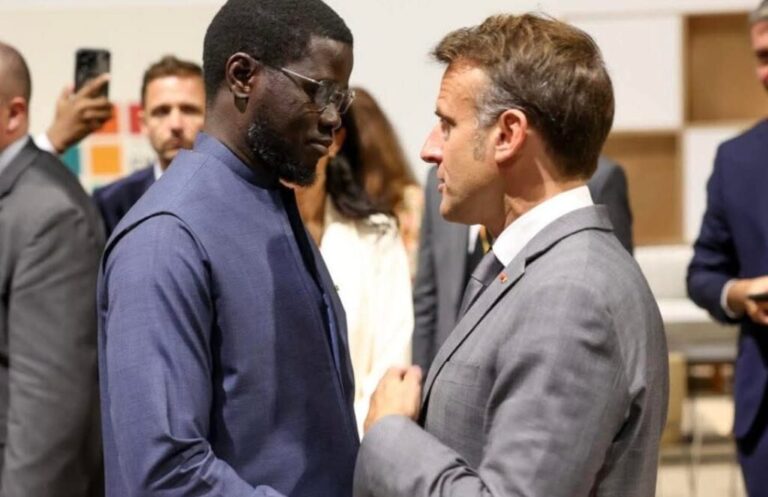
On the sidelines of the United Nations Conference on Financing for Development, the presidents of Senegal and France, Bassirou Diomaye Faye and Emmanuel Macron, met in Seville on Monday to express their shared commitment to strengthening cooperation between their two nations.
The discussions prioritized an enhanced partnership encompassing economic ties, security, culture, and remembrance.
“Our discussions focused on cooperation between Senegal and France, as well as regional and international issues of common interest,” stated Senegalese President Bassirou Diomaye Faye following the meeting at the 4th International Conference on Financing for Development (FFD4).
French President Emmanuel Macron reiterated that the Franco-Senegalese partnership is currently undergoing a significant overhaul. “It must allow us to move forward together in the service of the interests of our peoples and our sovereignty,” he posted on social media. Macron added, “Economic, security and defense, cultural, and memorial partnerships: these are all projects that we are closely monitoring with President Faye.” He further commended “Senegal’s commitment to regional stability and to addressing major global challenges.”
This meeting in Seville builds upon the dialogue initiated between the two leaders in June 2024 in Paris, during the Global Forum for Vaccine Sovereignty and Innovation. At that time, Presidents Faye and Macron had expressed a mutual desire to forge a renewed partnership grounded in principles of sovereignty, mutual respect, and shared democratic values. This evolving relationship coincides with the ongoing gradual withdrawal of the French Elements in Senegal (EFS), which commenced in March 2025 according to a schedule agreed upon by a joint Franco-Senegalese commission, signaling a broader redefinition of cooperative relations.
Economically, the ties between Dakar and Paris remain robust. Latest data from the National Agency for Statistics and Demography (ANSD) for April 2025 indicate that France was Senegal’s second-largest supplier, accounting for 10.2 percent of Senegalese imports. Bilateral trade primarily includes refined petroleum products, machinery, rice, and metals. The trade deficit for Dakar widened slightly to -56.4 billion CFA francs in April, from -52.4 billion the previous month. Conversely, Senegalese exports saw a 14.2 percent increase over the period, reaching 469.9 billion CFA francs, largely driven by crude oil, fish, and cement.
AC/Sf/fss/abj/APA