



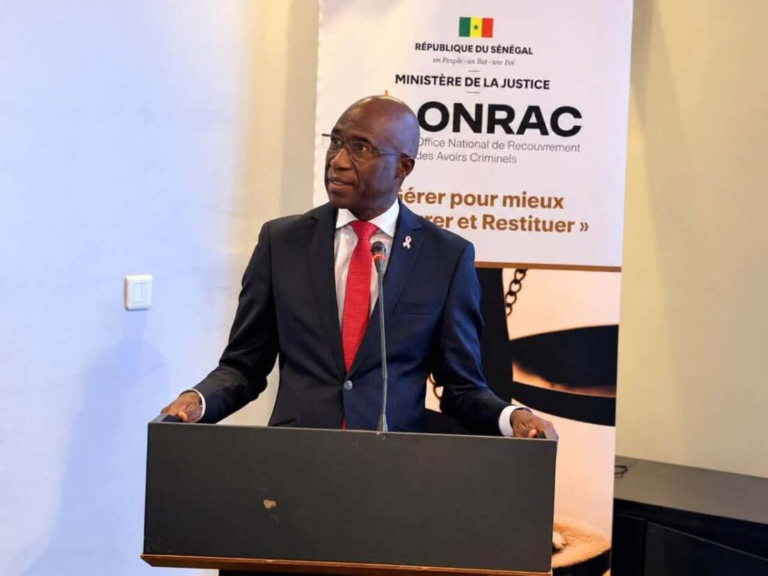
The National Office for the Recovery of Criminal Assets (ONRAC) has recovered more than CFAF50 billion since its establishment, Justice Minister and Keeper of the Seals Moussa Sarr said on Monday, calling for the entire criminal justice chain to be strengthened to prevent offenders from retaining the proceeds of their crimes.
“Crime must not pay,” the minister said at the opening in Dakar of a workshop on strengthening the capacity of criminal justice practitioners in the seizure, confiscation and recovery of criminal assets, being held from 5 to 8 October 2026.
For Sarr, convicting a defendant is not enough if assets derived from the offence remain at their disposal. “If the proceeds of an offence remain intact, the offender can regain access to them and the offence will ultimately have benefited them,” he said.
The minister recalled that ONRAC, established under Law No. 2021-34 of 23 July 2021, is one of the components of the national criminal asset recovery framework. He also cited the Financial Judicial Pool, established in 2023 and operational since September 2024, as well as the legal framework governing special investigative techniques and the reform of the seizure and confiscation regime.
He nevertheless stressed the need for better coordination among the various actors.
Investigators must identify assets, prosecutors must seek seizure orders, investigating judges must order seizures, courts must order confiscation, and ONRAC must then manage the assets and implement the relevant decisions.
According to the minister, asset tracing should begin from the earliest stages of proceedings to prevent assets from being concealed or transferred. He cited shell companies, life insurance policies and crypto-assets among the mechanisms that can be used to conceal assets.
The management of seized assets is also a major issue. Sarr called for ONRAC to be involved as early as possible to prevent assets held under judicial authority from deteriorating or losing value.
The minister also highlighted the international dimension of asset recovery, as capital can be transferred rapidly from one country to another. He encouraged practitioners to make greater use of the Camden Asset Recovery Inter-Agency Network (CARIN) and the Asset Recovery Inter-Agency Network for West Africa (ARIN-WA), which facilitate contacts between competent authorities involved in asset recovery.
While calling for greater effectiveness, Sarr stressed the importance of respecting the rights of persons facing prosecution. He recalled that seizure does not constitute a conviction and that those concerned must be able to challenge the measures taken, while bona fide third parties must be protected.
Over four days, judges, investigators, representatives of financial administrations, legal professionals, banking and insurance sector representatives and experts will work in particular on practical cases, the drafting of legal documents and a mock hearing.
The minister asked the Director-General of ONRAC to submit a report containing specific recommendations at the end of the workshop, with a view to improving practices and training for criminal justice practitioners.
The meeting is receiving technical and financial support from the African Legal Support Facility.
TE/lb/as/APA