





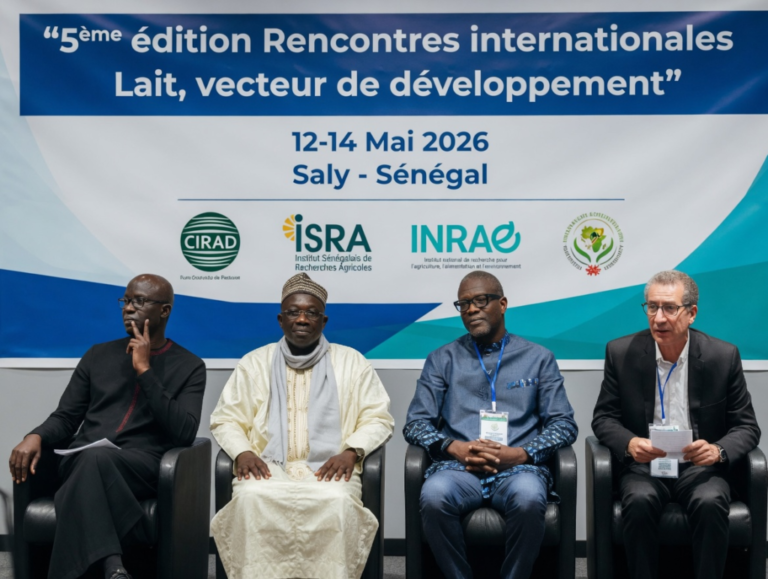
The 5th edition of the international conference “Milk, a Driver of Development” in Saly Portudal has highlighted the strategic necessity of transforming West Africa’s dairy sector, which currently remains trapped in a cycle of heavy import dependency.
Organized by Senegal’s Agricultural Research Institute (ISRA) in partnership with French research institutions Cirad and Inrae, the event serves as a platform for researchers, policymakers, and livestock farmers to reimagine the region’s dairy future. While the exhibition hall showcases the rich diversity of the Sahel—featuring fresh cheeses, camel milk from Niger, and “Touwa” camel-hump fat—the underlying discussions focus on a stark paradox: the region produces five billion liters of milk annually but processes less than 2% of that potential due to fractured collection systems.
The structural gap between production and consumption is the conference’s primary concern, as West Africa currently imports the equivalent of seven billion liters of milk to satisfy urban demand. Dr. Ibra Abdou Touré, regional director of Cirad, pointed out that behind every liter of locally processed milk is a network of families, women processors, and young entrepreneurs whose livelihoods depend on a functioning value chain. He argued that strengthening these local systems is no longer just an agricultural goal but a strategic response to climate, health, and geopolitical crises that threaten regional food sovereignty. Innovations like “Milk Link”—a passive cooling solution for preserving milk during transport from remote production areas—are being hailed as essential tools to bridge the distance between pastoral regions and industrial dairies.
The Senegalese government, represented by Professor Abdoulaye Dieng, acknowledged that domestic production currently covers only 38% of national demand, leaving the country vulnerable to global price fluctuations. To counter this, Senegal has unveiled a national food sovereignty strategy for 2025–2034, which aims to establish 500 dairy farms, 1,000 mini-dairies, and expanded fodder cultivation to improve herd productivity. As the conference concludes, the consensus among participants is that the future of the African dairy sector hinges on a transition from artisanal tradition to structured industrial markets, ensuring that the economic value of milk remains within local communities rather than flowing toward international suppliers.
ARD/te/Sf/lb/abj/APA