





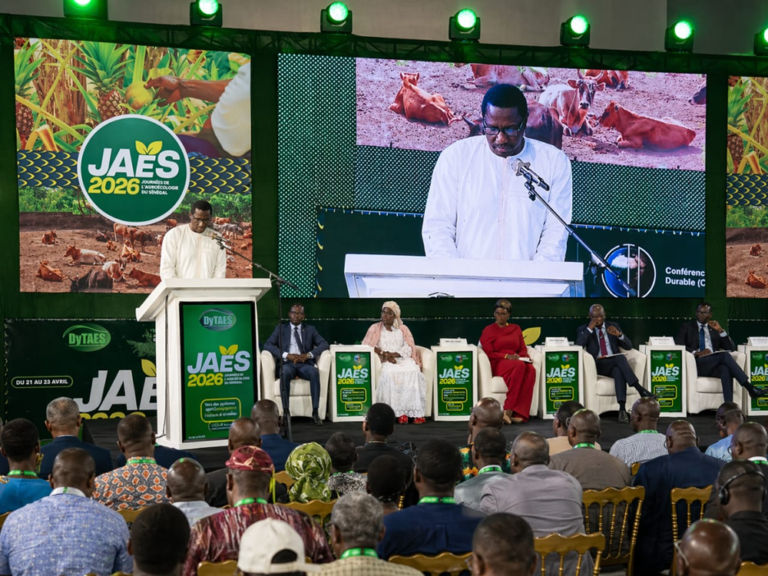
Local stakeholders in Senegal have resolved to making agroecology a sustainable pillar of public policy, with pledges regarding budgets and governance.
They had gathered in Dakar for the opening of the Senegal Agroecology Days (JAES 2026), the Ministers of Agriculture and the Environment, alongside DyTAES.
After years of advocacy and local experimentation, agroecology is reaching a new milestone in Senegal. Public authorities, local elected officials, producers, researchers, and civil society converged on Monday in Dakar around a common goal: to transform rhetoric into concrete decisions and to permanently integrate this approach into government action.
The fifth edition of the Senegal Agroecology Days (JAES 2026), held from April 21 to 23 in Dakar, opened under the theme: “From Vision to Action: Institutionalizing Agroecology for Sustainable Food Systems.”
The event marks a new stage in the political recognition of this agricultural model in the face of climate, food, and economic challenges.
For Dr. Laure Tall, Executive Director of IPAR, the debate is no longer about what agroecology is, but how to generalise it.
“Agroecology has proven itself. It is recognized as a credible response to the crises we are experiencing,” she stated, believing that the real challenge now lies in moving “from projects to systemic change.”
According to her, institutionalizing means going beyond written strategies to take responsibility for “funding choices, policy choices, and choices in practices.” She also emphasized the central role of local communities, deeming it impossible to ask them to implement the transition “without giving them the means to lead it.”
Co-chairing the opening ceremony, the Minister of the Environment and Ecological Transition, Dr. Abdourahmane Diouf, described food sovereignty as a “vital requirement” for Senegal. He maintained that agroecology represents “a path to the future,” capable of reconciling productivity, environmental sustainability, social inclusion, and economic performance.
The minister particularly highlighted the upcoming National Strategy for Agroecological Transition, jointly led by his department and the Ministry of Agriculture.
This joint leadership, he stated, reflects “a major shift in public policy,” based on integrated governance that transcends traditional sectoral approaches.
The agriculture, food sovereignty, and livestock minister echoed this sentiment, stating that “agroecology is no longer a luxury; it has become a necessity,” in an international context marked by soaring fertilizer prices and volatile markets.
He highlighted the initial measures already implemented, including the integration of organic inputs into public subsidies and the increase in state-supported volumes.
The minister also pledged to continue funding for youth, women, and rural communities. Keen to ensure that these commitments remain symbolic, he advocated for a mechanism to regularly monitor the national strategy. Otherwise, “every year we’ll come back here, we’ll make speeches, and nothing will get done,” he warned, proposing an implementation committee with measurable
objectives and quarterly or semi-annual reports.
The organisers of JAES 2026 aim to produce operational recommendations to strengthen the integration of agroecology into national regulatory and programmatic frameworks, while consolidating synergies between the state, local authorities, and civil society.
For the stakeholders present in Dakar, the challenge now goes beyond promoting an alternative agricultural model: it is about making agroecology a structuring lever for the economic, social, and
environmental transformation of Senegal.
ARD/ac/fss/as/APA