



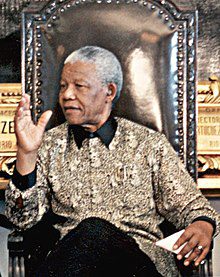
South Africa’s Constitutional Court is set to decide whether Nelson Mandela’s eldest daughter, Makaziwe Mandela, may auction personal items the government says form part of the country’s heritage.
The case, which opened on on Tuesday, follows a long-running dispute between the state and Mandela’s family over a planned sale of memorabilia held by the Mandela estate.
Makaziwe has said she intends to sell dozens of the late former president’s belongings through an international auction house in New York, arguing she has the right to dispose of inherited private property.
The items at the heart of the dispute include Madiba’s signature printed shirts, handwritten correspondence, his hearing aid and a green bar-coded identification document he used during South Africa’s first democratic election in 1994.
Opposing the auction are three heritage and cultural bodies: the South African Heritage Resources Agency (SAHRA), the Robben Island Museum, and the Department of Sport, Arts and Culture.
They argue that the collection is of profound national significance and is integral to South Africa’s cultural and historical identity, and that it should not be removed from the country.
Lower courts that previously considered the matter ruled against the state, finding that the government had not supplied sufficient legal proof that the items formally qualify as protected national heritage objects.
The courts also held that Mandela’s historical stature, on its own, does not automatically override the private property rights of his heirs.
Makaziwe has maintained that the items are inherited privately and that she is entitled to auction them.
She has said the proceeds would go towards funding the Mandela Memorial Garden and museum in Qunu, Eastern Cape where Mandela spent much of his childhood and where he is buried.
The legal fight comes more than a decade after Mandela’s death in December 2013, with his estate still not fully wound up.
JN/APA