





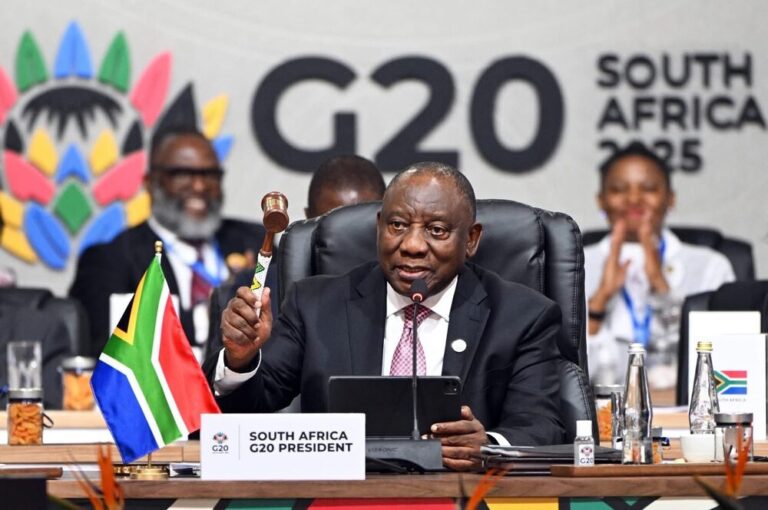
In a year defined by diplomatic warfare and shifting alliances, South Africa’s presidency of the G20 ended not in division but in defiance – and with a declaration.
Against the backdrop of US President Donald Trump’s boycott and repeated attempts to derail proceedings, a coalition of emerging middle powers asserted a new geopolitical current: one rooted in multilateralism, solidarity and progressive values.
Trump’s absence, long anticipated after months of hostile rhetoric, ultimately became beneficial for the gathering as it resulted in a constructive outcome.
His administration had sought to block the adoption of a G20 Leaders’ Declaration, warning against consensus and pushing instead for a watered-down chairperson’s summary.
Yet 16 member states and 25 invited leaders pressed ahead, signalling solidarity with Africa and South Africa, and underscoring their own interests in a continent rich in youth and critical minerals.
Only Argentina’s President Javier Milei aligned with Washington’s stance, although his boycott was partial, with his foreign minister attending.
The US refusal to engage highlighted a broader trend: the rise of middle powers willing to resist unilateralism and reaffirm the global rules-based system.
The Johannesburg summit became a showcase for countries such as India, Brazil, Australia, Canada, Singapore, Indonesia, Malaysia, Turkey and the Gulf states.
These nations, while diverse in outlook, share a commitment to multilateralism and progressive cooperation.
Bilateral meetings across the city reflected efforts to diversify trade in the wake of US tariffs while leaders repeatedly stressed the importance of collective action.
The consensus declaration adopted at the summit threaded together urgent priorities:
• Inequality: Recommendations from a panel led by Nobel laureate Joseph Stiglitz were incorporated, highlighting pathways to mediate global disparities.
• Debt relief: Proposals from former South African finance minister Trevor Manuel on debt sustainability and risk pricing won broad support.
• Progressive values: South Africa’s chosen themes of solidarity, equality and sustainability were affirmed, countering the global rise of conservatism.
• Climate and Just Transition: A marquee bilateral agreement between the EU and South Africa bolstered commitments to a just energy transition, with Norway, the UK and others pledging development support.
The US had demanded a high-profile handover of the G20 presidency to its chargé d’affaires but President Cyril Ramaphosa refused, insisting on equivalence.
The baton will instead pass in a low-key ceremony at South Africa’s Department of International Relations and Cooperation – a symbolic final act of defiance that underscores shifting relationships.
For South Africa, the summit’s close represents more than a diplomatic victory.
It signals a recalibration of global politics beyond the gravitational pull of superpowers.
The G20’s affirmation of multilateralism, achieved in the face of unprecedented pressure from Washington, suggests that geopolitics may be entering a post-Trump phase – one where middle powers, progressive values and solidarity shape the global agenda.
JN/APA