



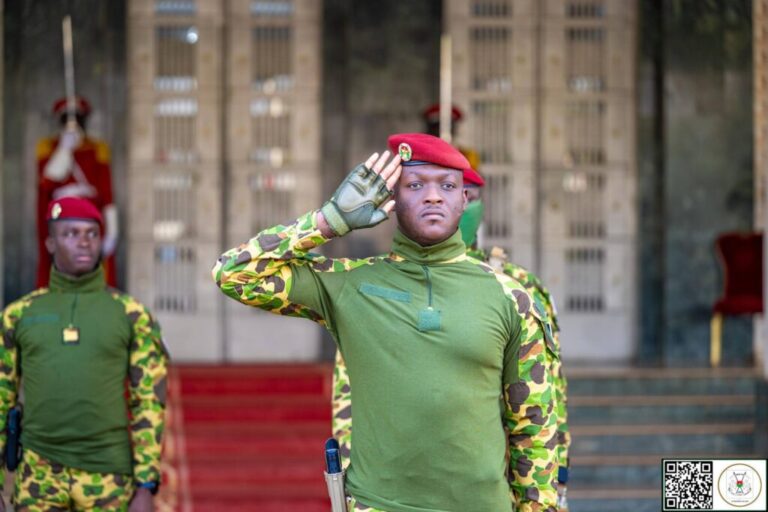
Burkina Faso’s transitional leader, Captain Ibrahim Traoré, ushered in 2026 with a bold vision for “accelerated transformation,” calling on the nation to maintain its revolutionary momentum during the year’s first official flag-raising ceremony at Koulouba Palace.
Addressing a determined crowd on Monday, January 26, 2026, the Head of State reviewed a landmark 2025 and set an intense pace for the coming months, urging citizens to prepare for a period of rigorous self-improvement and high-speed development.
A cornerstone of the President’s address was the celebration of 2025’s “record production” in agriculture, which he claimed has led the country to food self-sufficiency. Traoré highlighted the successful cultivation of crops previously thought unsuited for the Burkinabe climate, including wheat, pineapples, and even cocoa and coffee. He reinforced a strictly nationalist economic policy, stating that the objective is to produce and process goods locally for domestic consumption rather than for export. This “farm-to-table” sovereignty is already being realized by Burkinabe master chocolatiers and coffee roasters who are transforming raw materials into high-value products within the country.
On the social front, Traoré announced a sweeping overhaul of the national education system intended to bridge the country’s technological gap. The 2026 roadmap includes the rapid rollout of numerous vocational and technical high schools alongside the completion of a dedicated technological university. Underscoring this scientific push, the President revealed that Burkina Faso has acquired a state-of-the-art scanning electron microscope—described as the most advanced on the continent—to enable national researchers to conduct cutting-edge work without relying on foreign facilities.
The administration’s approach to infrastructure remains defiantly independent. Traoré defended the ongoing highway projects being executed by the Faso Mebo agency and young Burkinabe engineers using a “self-construction” model. By rejecting expensive foreign funding, the government claims to be utilizing specialized equipment unique to Africa while keeping capital and expertise within the country. This model is part of a broader strategy to ensure that national development projects are not beholden to external “imperialist” interests or debt cycles.
Addressing the nation’s most pressing challenge, the President lauded the “irreversible march” of the Defense and Security Forces (FDS) and the Volunteers for the Defense of the Homeland (VDP). He noted that government troops have successfully reached several border regions as part of an ongoing campaign to restore territorial integrity. Despite what he characterized as disinformation campaigns from foreign actors, Traoré expressed absolute confidence in the Burkinabe people’s ability to achieve total territorial recapture and industrial sovereignty by the end of 2026.
HO/Sf/fss/abj/APA