





Tunisia’s President Kais Saied’s alignment with the Iranian axis and his anti-Israel rhetoric serves to consolidate a weakened political legitimacy at home and comes with the risk of international isolation.
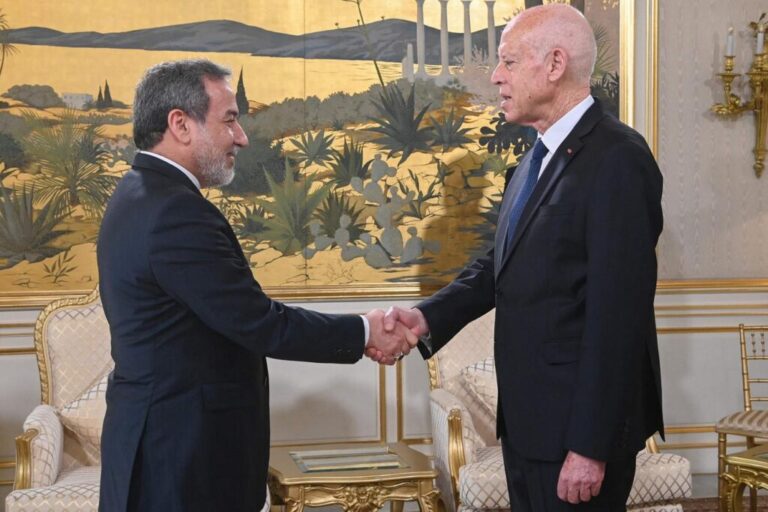
Saied is pursuing his rapprochement with Iran amid a drift toward authoritarianism denounced by his opponents and international observers. On September 10, he received Iranian Foreign Minister Abbas Araghchi at the Carthage Palace, confirming a diplomatic stance that accentuates Tunisia’s isolation from its traditional partners.
This meeting came as the Bay of Tunis hosted the ships of the “Global Sumud Flotilla,” which had been targeted a few days earlier by two drone attacks attributed by their organisers to Israel. The Tunisian presidency’s statement mentioned discussions focused on “attacks on security and stability, particularly in occupied Palestine.”
For its part, the Iranian foreign ministry denounced “genocide in Gaza” and the “crimes of the Zionist regime,” echoing rhetoric that places Tunis in Tehran’s diplomatic orbit.
The Iranian foreign minister’s meeting with his Tunisian counterpart, Mohamed Ali Nafti, focused on a range of possible cooperation in trade, tourism, health, and technology. But behind these announcements, it is Kais Saied’s political strategy that is raising questions. Since his institutional coup in 2021, marked by the suspension of parliament and the concentration of executive and judicial powers, the head of state has been accused of dictatorial excesses. The repression of opponents, the marginalisation of political parties, and the absence of checks and balances have pushed Tunisia into an authoritarian transition that worries its European
partners.
In this context, rapprochement with Iran appears to many to be a risky choice. By forging closer ties with Tehran, Tunis is exposing itself to the hostility of its Gulf neighbours, particularly Saudi Arabia and the United Arab Emirates, who fear an expansion of Iranian influence.
The European Union, Tunisia’s main economic partner, is cautiously observing this diplomatic shift, given that the country relies heavily on its financing.
For Kais Saied, alignment with the Iranian axis and anti-Israel rhetoric serve to consolidate a weakened political legitimacy at home.
But this choice risks accelerating the isolation of Tunisia, already weakened by the economic crisis, the collapse of the dinar, and the distrust of a portion of the population.
More than ever, the country is moving away from its image as a democratic exception born of the “Arab Spring” and sliding toward a self-proclaimed authoritarianism, to the detriment of its strategic alliances and internal stability.
MK/ac/Sf/fss/as/APA