



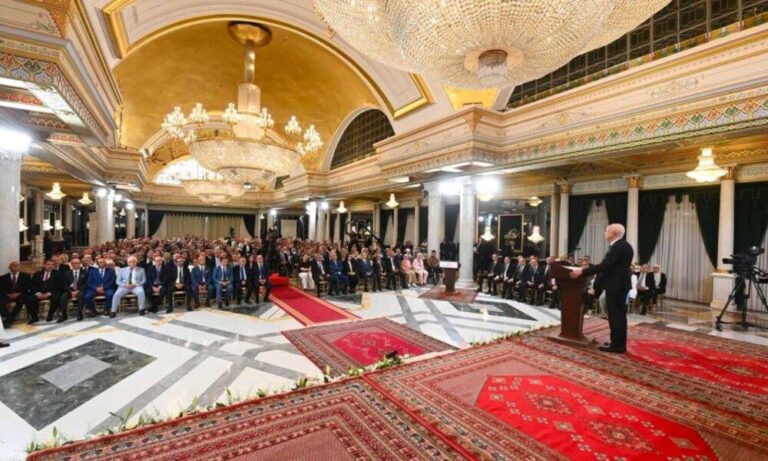
Tunisian President Kais Saied reaffirmed national sovereignty in education policy on Monday, during Knowledge Day at Carthage Palace, while also announcing the start of the work of the Higher Council for Education.
The Tunisian head of state placed education reform under the banner of national sovereignty. At a ceremony held on Monday, August 17, at the Carthage Palace, in the presence of the head of government, members of the executive branch, senior state officials, and graduates from the
past academic year, Kais Saied rejected any external influence on the direction of the education system.
“No to diktats from abroad. We choose our education as the Tunisian people want it,” the president declared in an address broadcast by the presidency.
According to him, certain past external interventions have contributed to altering the national character of Tunisian education. He defended a system that was “national, democratic, and universal,” also stating that compulsory schooling should not necessarily end at sixteen.
This intervention coincided with the establishment of the Higher Council for Education, a constitutionally mandated institution whose members have been appointed. Kaïs Saïed indicated that this body began its work the same day and that it would be tasked with conducting an
“objective” reform, free from political calculations and short-term fluctuations.
More ambitious educational projects are expected to be announced when the conditions for their implementation are met.
The Tunisian president also emphasized the transformation of schools into spaces for cultural transmission. He expressed his desire for the development of clubs dedicated to film, theatre, and calligraphy, while criticising the architectural shortcomings and lack of cultural facilities in many schools. A centre dedicated to the art of calligraphy is also being considered.
Kais Saied finally addressed the rise in drug use, calling for increased awareness campaigns in schools and public media. He accused corruption networks and intermediaries funded both internally and externally of seeking to destabilise Tunisian society, thus framing educational reform within a broader concept of national sovereignty and cohesion.
MK/Sf/fss/as/APA