



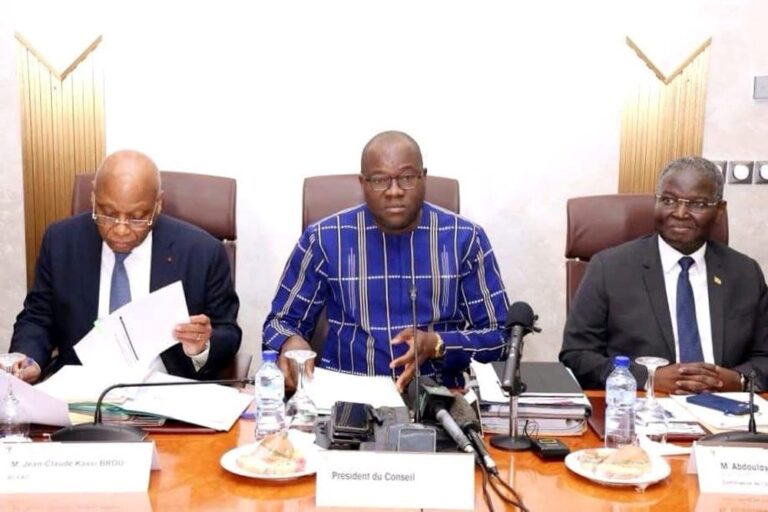
A meeting in Ouagadougou of ministers of the West African Economic and Monetary Union (UEMOA) has painted a picture of a resilient regional economy, driven by sustained growth, controlled inflation, and improved external accounts, despite a highly tense international context.
The UEMOA economy continues to demonstrate its resilience in the face of global economic
turbulence, with growth estimated at 6.1% in the first quarter of 2026, declared Aboubakar Nacanabo, President of the Union’s Council of Ministers, on Friday in Ouagadougou, at the opening of the organisation’s second ordinary session.
According to the Burkinabe Minister of Economy and Finance, this growth, following 6.5% in the fourth quarter of 2025, confirms the strength of the economic fundamentals of the eight member states.
The growth rate is expected to remain at 6.1% for the whole of 2026, despite an international environment marked by geopolitical tensions and a slowdown in the global economy.
The Union is also benefiting from favourable price developments.
Inflation stood at -0.2% in the first quarter of 2026, reflecting price stability, while it is expected to reach 1.6% for the year as a whole, despite persistent pressure on energy prices and certain
imported food products.
The Union’s external performance has also improved. member states recorded an overall balance of payments surplus, supported by growth in trade in goods and services as well as an increase in net capital inflows, thus strengthening the external position of the EU.
On the budgetary front, efforts to consolidate public finances are continuing.
The overall deficit is projected to decrease from 3.3% of gross domestic product (GDP) in 2025 to 3.2% in 2026, before reaching 2.9% in 2027, reflecting the commitment of member states to restoring macroeconomic stability while maintaining the investments necessary for their development.
However, UEMOA authorities emphasised that the outlook remains subject to several risks, including uncertainties in the international economic climate, security and socio-political challenges in the
region, and the increasing effects of climate change.
Despite these constraints, Union officials believe that current economic indicators confirm the community’s capacity to preserve its macroeconomic stability and maintain sustained growth momentum.
HO/ac/fss/as/APA