



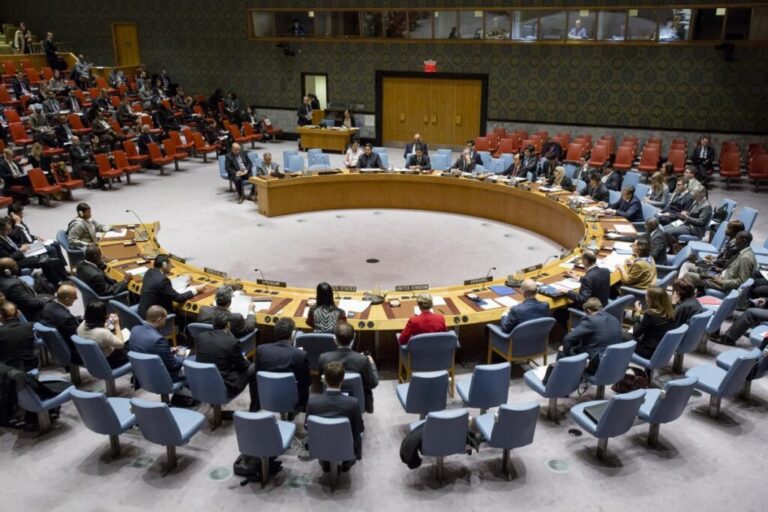
The UN Security Council has renewed the authorisation allowing European Union naval forces to inspect vessels off the Libyan coast, in a bid to reinforce an arms embargo in place since 2011.
The Security Council adopted a new resolution extending the mandate that permits European naval forces to board and inspect ships suspected of violating the arms embargo on Libya.
The authorisation, in force since 2016, forms one of the operational pillars of the international mechanism tasked with ensuring compliance with the restrictive measures imposed on the country since the outbreak of conflict in 2011.
France’s ambassador to the UN, Jérôme Bonnafont, said the renewed mandate reflects “the Council’s steady support for efforts to stabilize Libya.” He stressed that the arms embargo remains “essential” to preventing a resurgence of violence, particularly in sensitive areas around Tripoli, where sporadic tensions persist among armed groups. While commending the work carried out under the EU’s Operation Irini, he said the mission continues to operate “professionally, impartially and effectively,” in close coordination with Libyan authorities and neighbouring states.
Launched by the European Union in 2020, Operation Irini has become the main maritime monitoring tool for enforcing the embargo, succeeding earlier mechanisms established by Brussels. Its mandate allows for the inspection of vessels on the high seas when there are reasonable grounds to suspect illicit transfers of weapons to or from Libya. EU member states contribute naval, aerial and satellite assets to document violations and report them to the UN Sanctions Committee.
However, the UNSC’s decision was not unanimous. Russia and China abstained, voicing strong reservations about the mission’s actual effectiveness. Russia’s Deputy Ambassador, Anna Evstigneeva, argued that the mechanism “remains de facto controlled by the European Union” and that “European praise does not reflect reality,” pointing to the absence of any significant reduction in arms trafficking.
Moscow maintains that a more balanced mechanism, less dependent on European resources, would ensure a more credible implementation of UN sanctions.
MK/ak/lb/as/APA