





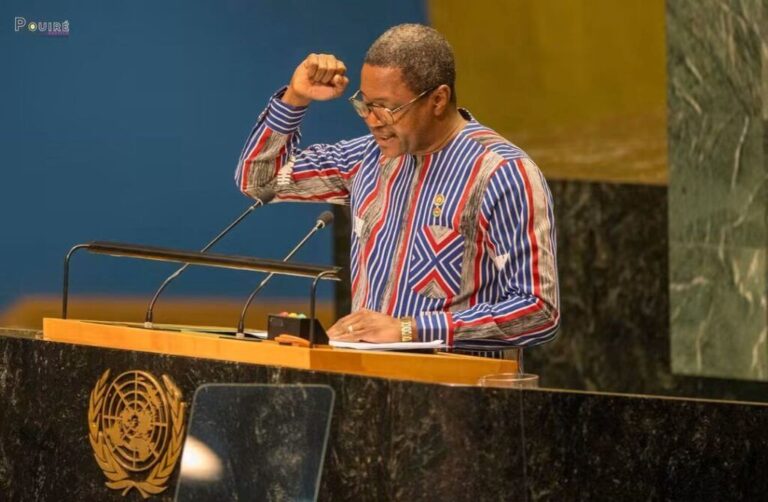
Speaking on behalf of the Confederation of Sahel States (AES), Burkina Faso called on Monday for
profound reform of the multilateral system and denounced “double standards” in international relations.
Addressing the UN General Assembly, Burkinabe Foreign Minister Karamoko Jean Marie Traore also defended the sovereignty of AES states and highlighted the progress Ouagadougou claims to have achieved in the security and economic spheres.
The tone was assertive. “We ask no one for permission to exist,” declared Burkinabe Foreign Minister Karamoko Jean Marie Traore at the 81st session of the UN General Assembly, speaking on behalf of the leaders of Burkina Faso, Mali, and Niger.
The Burkinabe foreign minister argued that trust among UN member states has been “eroded” by “double standards,” “biased positions,” and the “use” of international institutions.
He called for the United Nations to become an organization founded on “equality in dignity, rights, and sovereignty.”
Regarding security, the AES accused certain states of supporting terrorist groups. Mr. Traore called for international investigations into alleged support – in terms of funding, weaponry, and intelligence – for these groups.
He also defended the measures taken by the three countries in the fight against jihadism. The AES maintains that it is facing a destabilisation campaign backed by significant resources.
The minister also reaffirmed the confederation’s commitment to reforming the UN Security Council. He cited the Ezulwini Consensus and the Sirte Declaration as benchmarks for ensuring better representation for Africa.
The AES also supported the UN80 initiative and called for a reform of international financial governance, particularly regarding debt, access to financing, and the representation of developing
countries.
Mr. Traore welcomed two resolutions recently adopted by the General Assembly. The first, adopted on March 25, 2026, recognizes the transatlantic trade in enslaved Africans and racialized slavery as the “gravest crimes against humanity.”
The second, spearheaded by Togo, was adopted on September 4 and concerns a more equitable cartographic representation of Africa.
74% of Burkinabe territory under control
In the section dedicated to Burkina Faso, the minister stated that more than 74% of the national territory was now under the authorities’ control.
He highlighted the retaking of localities, the return of displaced populations, the reopening of schools and health centres, and the gradual restoration of administrative services.
Economically, Ouagadougou intends to accelerate the local processing of raw materials and strengthen productive capacities. The 2026-2030 Recovery Plan is intended to serve as the framework for this transformation, the minister indicated.
Regarding the Middle East, Burkina Faso reaffirmed its support for a two-state solution – Israel and Palestine – living side by side “in peace and security.”
Ouagadougou also called for dialogue concerning sanctions targeting, in particular, Cuba and Nicaragua.
On Western Sahara, Burkina Faso reaffirmed its support for the political process led under UN auspices.
The statement concluded with the AES motto – “One people, one space, one destiny” – followed by slogans dedicated to the Sahel and Africa.
HO/te/Sf/fss/as/APA