





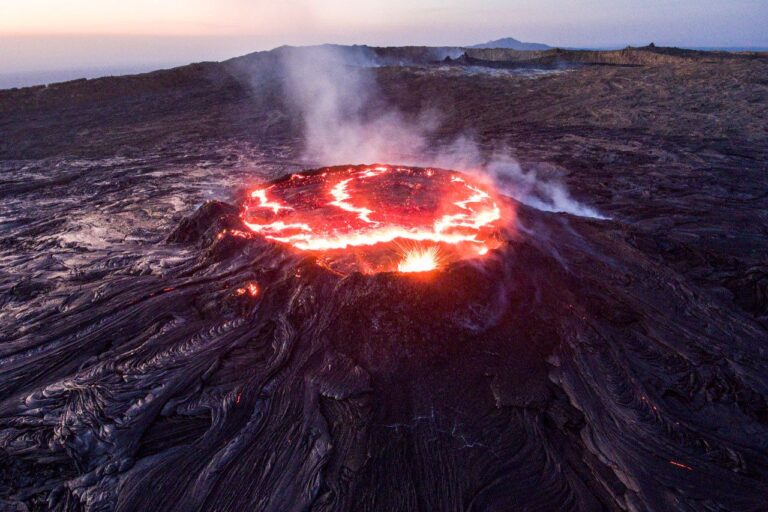
A volcanic eruption occurred on Sunday at Mount Erta Ale, one of Ethiopia’s most active volcanic areas, sending thick plumes of ash and smoke high into the sky.
The eruption occurred around 10:00 a.m. local time was unusually strong in both size and sound, the Ethiopian Geological Survey said, confirming that it was the most powerful explosion witnessed in recent years.
The explosion triggered a massive ash column that drifted over nearby communities, heightening concern among local residents.
Prof. Atalay Ayele, Head of the Seismology Department at the Institute of Geophysics, Space Science and Astronomy at Addis Ababa University, said that the eruption was caused by the movement of active lava.
He noted that the eruption occurred roughly 10 kilometers south of Erta Ale, and that geophysics researchers have been dispatched to study the situation.
Ayele said the Danakil Depression, part of the Great East African Rift Valley, is a region of active volcanic activity, and that eruptions in the area are typically caused by the erosion and movement of active rocks.
Lava flows trigger eruptions ranging from low to high intensity. Such eruptions may hurl rocks and stones into the air and generate heavy smoke and ash.
Authorities have not yet issued details on potential impacts or safety advisories, although residents reported visible ash fall in surrounding areas.
Mount Erta Ale, located within the Danakil Depression, recorded multiple eruptions over the past decades.
MG/as/APA