





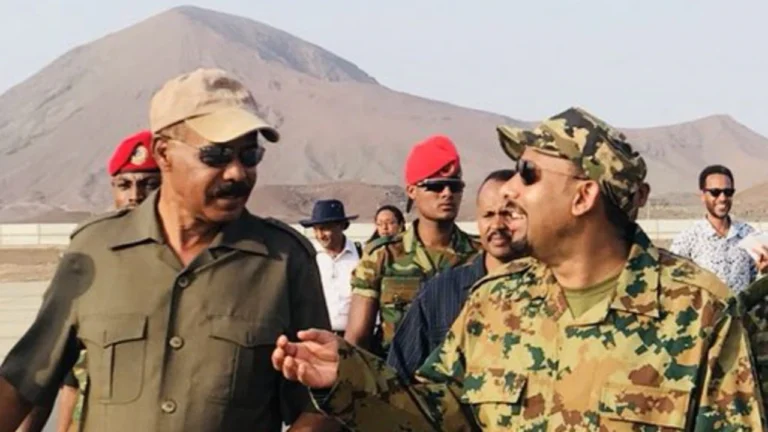
Eritrea over the weekend dismissed allegations by Ethiopia that it violated the sovereignty of its neighbour to the south.
Tension has escalated between the two old foes as landlocked Ethiopia continues to insist on access to the Red Sea, where its ambition is to construct a port and establish a military base. Asmara regards this unilateral ambition as encroaching on its territory.
Last Thursday, Ethiopia’s foreign affairs ministry Gedion Timothewos accused the Eritrean government of military provocation with its troops encroaching on Ethiopian territory.
Addis Ababa also accused Asmara of interfering in the internal affairs of Ethiopia by way of forming alliances and backing armed groups fighting the Ethiopian federal government.
Yemane Gebremeskel, Eritrea’s minister for information described the Ethiopian foreign minister’s remark as a belligerent manifesto, noting that Addis Ababa’s plan to launch war against Eritrea seems to be morphing – through constant packaging and repackaging.
Gebremeskel, on social media, said Eritrea sees Ethiopia’s ruling party statement as its current war agenda cloaked in ‘sovereign access to the sea’.
“The transparent ploy is designed to hoodwink public opinion by rationalising the unprovoked and reckless war that Addis Ababa has been itching to unleash against Eritrea for the past two years,” he said.
Ethiopia claims that its lack of sea access reduces its trade efficiency, incurs high transportation costs, limited or lower foreign direct investment, high rate of unemployment, and a 20-30 percent reduced economic growth compared to its littoral neighbors.
Ethiopian authorities said as a regional security anchor in the Horn of Africa and the eastern half of the Southern Red Sea gate, Ethiopia’s role in regional security has been hindered by its lack of direct maritime corridor.
Ethiopia became landlocked after Eritrea seceeded in the early 1990s, taking with it the ports of Assab and Massawa.
MG/as/APA