



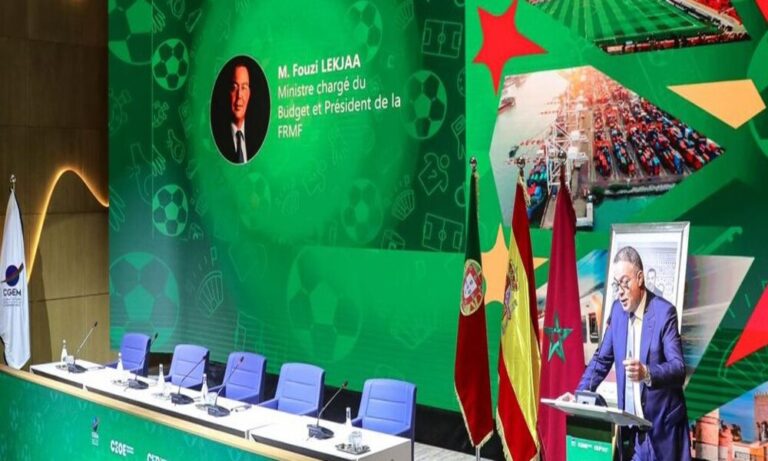
The Mohammed VI Football Complex in Salé served as the backdrop for the Morocco-Spain-Portugal Business Forum on Tuesday, February 10, 2026, where leaders gathered to outline the economic roadmap for the 2030 World Cup.
Co-organized by the leading business confederations of the three host nations—CGEM for Morocco, CEOE for Spain, and CIP for Portugal—the forum emphasized that this centennial edition of the tournament is far more than a sporting event. Instead, it is being positioned as a transformative project designed to unify two continents through a shared logistical, cultural, and financial framework.
Fouzi Lekjaa, President of the Royal Moroccan Football Federation and Minister of Budget, underscored the unprecedented nature of the tournament’s format. With over 100 matches distributed across three neighboring countries, the event will require a seamless integration of transportation, security, and logistics. Lekjaa noted that a single team might compete in Madrid, Marrakech, and Lisbon in rapid succession, necessitating a level of cross-border coordination never before seen in FIFA history. He pointed to Morocco’s successful hosting of the recent Africa Cup of Nations (AfCON) as definitive proof of the region’s readiness, highlighting that the infrastructure and organization were entirely managed by domestic firms and professionals.
The economic ambitions discussed during the forum extend deep into the industrial sectors of all three nations. Chakib Alj, President of the CGEM, characterized the World Cup as a “structuring project” that will catalyze long-term investment in infrastructure, mobility, tourism, and technology. Morocco is already moving forward with massive public works, including doubling airport capacities, expanding the national highway network, and extending high-speed rail lines to accommodate the anticipated influx of global visitors. The goal is to move beyond temporary sporting fever and instead create a lasting legacy of value and sustainable development.
The forum concluded with a call for joint innovation and partnership, with representatives from the Spanish and Portuguese embassies echoing the sentiment that the 2030 World Cup will be “extraordinary” due to its unique geographical and cultural complementarity. By leveraging centuries of shared history, the three nations aim to build a unified economic corridor. This strategy intends to transform the tournament into a driver for modernization in health, education, and digital services, ensuring that the financial momentum generated by the games benefits the youth and the broader populations of the Mediterranean region for decades to come.
SS/Sf/fss/abj/APA