





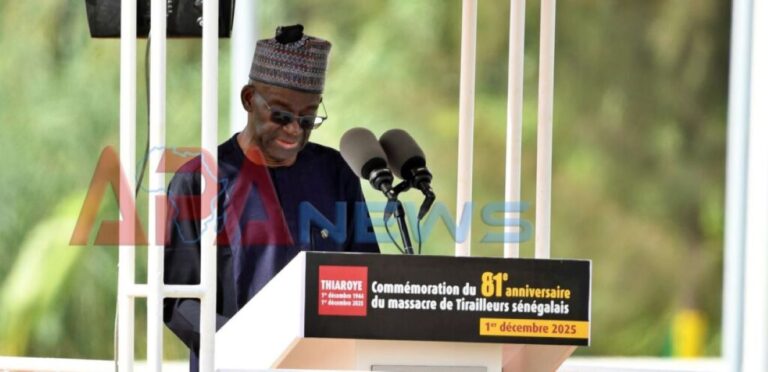
The commemoration of the 81st anniversary of the Thiaroye massacre was held on Monday in the Senegalese capital Dakar, marked by calls for the opening of archives and continuing historical research on this colonial-era event.
The ceremony organised to remember the Thiaroye tirailleurs brought together historians, Senegalese officials, and African invitees.
The president of the commemoration committee, historian Mamadou Diouf, described the date as “an opportunity to open a file emblematic of colonial governance practices.”
He recalled that the events of 1944 were marked by “a double maneuvre of concealment and reconfiguration,” pointing to the limitations of research conducted on the subject to this day.
According to Diouf, strengthening the commemoration cycles now fits into a broader regional and Pan-African perspective and posited that Thiaroye today represents “a living memory, the bearer of an African consciousness.”
Diouf highlighted the need to intensify historical investigations, support artistic and educational works, and promote an autonomous memory.
He presented a White Paper published by the Senegalese government as “an unprecedented sequence”, making available archives that had long remained in the shadows.
“Our only guiding principle remains the requirements of truth,” he concluded, calling on African states to pursue research and document colonial crimes.
Enter Tiémoko Meyliet Koné
Ivorian Vice President Tiémoko Meyliet Koné, a guest at the commemmoration, reiterated the regional importance of the remembrance.
“Justice, however delayed, remains a requirement,” he declared, referring to the African tirailleurs who had “returned from the war front and became victims of repression of extreme violence.”
He noted that those war veterans fought “in the name of a universal ideal known as freedom.”
According to Koné, “peace and dialogue remain the only paths capable of preventing the recurrence of such tragedies.”
Highlighting Côte d’Ivoire’s contribution to the contingent of tirailleurs, he admitted that his country bears “a moral responsibility in the preservation of this memory” and pledged a commitment to “transmitting the history of this tragedy to future generations.”
He concluded: “May the memory of Thiaroye be constant, and may it strengthen our commitment to peace, justice, and human dignity”.
In the early morning hours of December 1, 1944, between 1,200 and 1,800 tirailleurs hailing from 17 African countries were mowed down in a massacre perpetrated by 1,200 men from a colonial troop detachment and the French gendarmerie.
They had been demanding the payment of their indemnities and wages following their heroics against the Axis in the Second World War.
SS/ac/lb/as/APA