



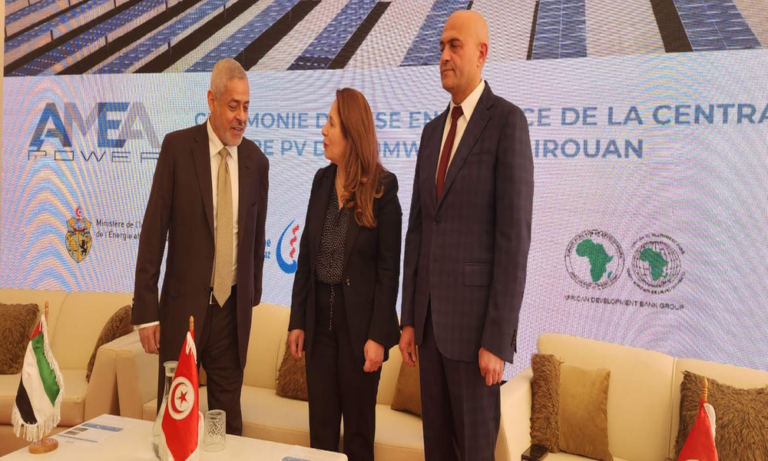
The African Development Bank (AfDB) has formally lauded the commissioning of the Kairouan photovoltaic solar power plant, labeling it a cornerstone of Tunisia’s strategy for energy transition and national security.
The plant, which officially began operations on December 16, 2025, represents a significant leap forward in the country’s push toward renewable energy and regional development.
Developed by AMEA Power in collaboration with Tunisian authorities, the Kairouan facility is the first in Tunisia to surpass 100 megawatts of installed capacity. It utilizes an innovative system to inject electricity directly into the national high-voltage grid.
The project aligns with Tunisia’s national goal to have 35% of its installed energy capacity come from renewable sources by 2030.
The AfDB highlighted the plant’s operational capacity and its role in reducing environmental impact: Annual Production: The plant is expected to generate approximately 222 gigawatt-hours of clean electricity every year. Household Power: This output is sufficient to supply electricity to nearly 43,000 homes. Carbon Reduction: The project will prevent roughly 117,000 tons of CO₂ emissions annually. Energy Independence: By producing local solar power, Tunisia can reduce its reliance on volatile international fossil fuel markets and imported energy.
The African Development Bank played a vital role in the project’s success by contributing $25 million. These funds were sourced from the Bank’s own capital and the Sustainable Energy Fund for Africa (SEFA) to help mobilize further commercial and concessional investments.
Malinne Blomberg, AfDB Deputy Director General for North Africa, noted that the project marks a “decisive step” for Tunisia. The Bank intends to use the Kairouan project as a benchmark for future Independent Power Producer (IPP) programs in the region, reinforcing its commitment to resilient green growth and climate action.
MK/AK/Sf/fss/abj/APA