



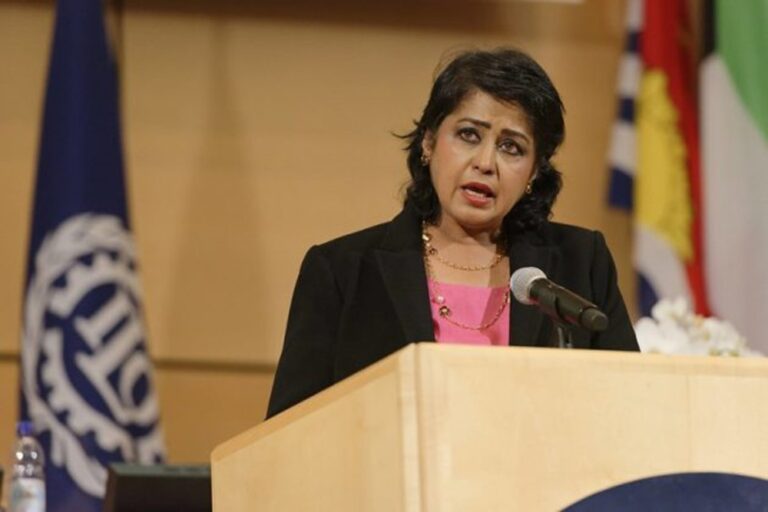
At the opening of the COP30 Media Lab in Nairobi, former Mauritian President Dr. Ameenah Gurib-Fakim called for a radical shift in how Africa’s role in global climate negotiations is perceived and represented.
“A single company, NVIDIA, has a market capitalisation of 4.1 trillion dollars. The combined GDP of the entire African continent stands at 3.1 trillion.”
This striking comparison, made by Dr. Gurib-Fakim during her address at the COP30 Media Lab and Dialogue on Monday, encapsulates the economic paradox facing Africa. Speaking to an audience of journalists and climate stakeholders, she urged a new narrative — one that redefines Africa’s place in the climate equation.
The event, organised by Distory Communications and Africa Climate Insights (ACI), comes as the international community prepares for the 30th UN Climate Change Conference (COP30).
A scientist specialising in biodiversity and now chair of the Wise Council of ImpactHER, Dr. Gurib-Fakim framed climate discussions through an economic lens.
“Think about it in financial terms,” she said. “When countries issue bonds, they pay coupons until maturity. In climate terms, it’s as if Africa has subsidized a handful of countries without ever being repaid.”
Africa, she stressed, contributes less than 4% of global greenhouse gas emissions yet remains among the regions most affected by climate change. “We are not asking for charity. We are not begging,” she insisted, rejecting the outdated aid-driven narrative surrounding Africa’s climate position.
The double debt trap
The former president also addressed the growing weight of financial debt on African economies. Citing recent data, she noted that the debt-to-GDP ratio in sub-Saharan Africa rose from 30% in 2013 to over 60% in 2022.
“African countries that issue bonds must repay them in 10 years at high interest rates,” she explained, contrasting this with developed nations’ access to long-term, low-interest financing. “To avoid defaulting internationally, they default domestically — on health, education, and social safety nets.”
Meanwhile, 12 million young Africans enter the labour market every year, with only 3 million formal jobs created, further straining economic resilience.
Dr. Gurib-Fakim highlighted several structural contradictions: Africa imports over $50 billion in food annually, despite possessing 60% of the world’s arable land. At the same time, 600 million Africans still lack access to electricity.
“Through the critical minerals we possess, Africa powers technologies developed elsewhere,” she said, underlining the continent’s overlooked contribution to the Fourth Industrial Revolution.
Nearly a decade after the Paris Agreement (COP21), she lamented that Africa has yet to receive the promised technologies and tools needed to transition to green energy. Without these, she warned, new environmental trade standards could penalise Africa before it even has the means to comply.
A call for structural reform
Dr. Gurib-Fakim advocated for debt restructuring, favoring extended repayment periods and fairer interest rates over blanket debt cancellation. She also emphasised regional integration as a strategic imperative.
“If African countries could come closer together, better coordination among a few influential states could accelerate economic integration and industrialisation,” she said.
She urged governments to mobilise sovereign resources, such as pension funds, to finance local development rather than relying exclusively on external capital.
The role of the media
Highlighting the influence of journalism, Dr. Gurib-Fakim urged African media to take control of the continent’s story.
“When we create our own agencies, we shape the narrative,” she said, calling on journalists to focus on solutions and economic transformation rather than the usual depictions of poverty and crisis.
“Africa has been a victim of circumstance,” she concluded. “But we are here to offer solutions.”
She stressed the importance of African negotiators staying until the very end of international climate talks to ensure that “no decisions are made in their absence.”
The COP30 Media Lab and Dialogue continues this week in Nairobi, bringing together journalists, policymakers, and experts to prepare media coverage ahead of the next UN Climate Conference.
ARD/ac/sf/lb/as/APA