



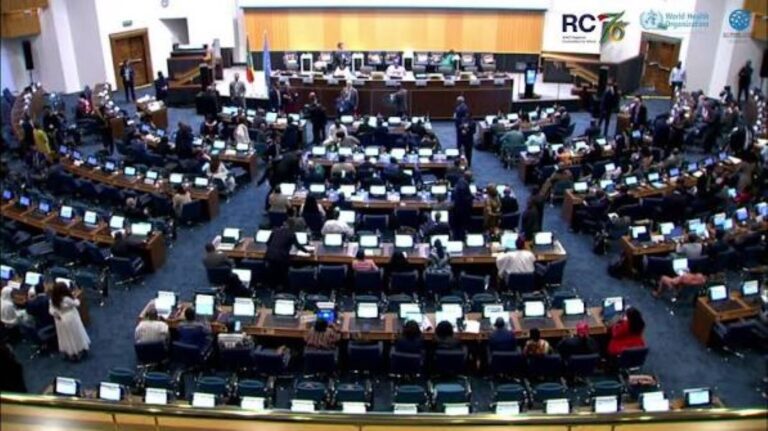
The 76th Session of the WHO Regional Committee for Africa opened on Tuesday in Addis Ababa, the capital of Ethiopia, aiming to shape the continent’s health priorities and end dependency on external financing.
The session has brought together 47 health ministers from across Africa, development partners and technical experts to review progress,address emerging health challenges and endorse regional strategies to strengthen health systems and improve people’s health across the continent.
Opening the session, Taye Atske Selassie, President of Ethiopia, called for stronger regional cooperation and sustained investment in resilient health systems to improve people’s health across the continent.
“Africa’s next health chapter must be defined by ownership over dependency, integration over fragmentation and practical action over words. Let us act not only with declarations, but with firm commitment and measurable actions,” Atske Selassie said.
“We must not sit here and adapt to reforms designed elsewhere,” the president said, while urging African countries to shape the health agendas in line with their own vision.
“This is an important step toward reducing the nearly 7 billion U.S. dollars our continent spends each year referring patients abroad. Our vision is simple: strengthen Africa’s centers of excellence, connect African patients to African expertise, and keep Africa’s investments working for Africa,” Janabi said.
Mekdes Daba, Ethiopian Minister of Health, called for efforts to build sustainable health systems for Africa’s future, noting that the region faces new challenges including persistent inequalities, resource constraints, emerging technologies, climate issues, demographic transitions and complex health emergencies.
“If we act in solidarity, invest with purpose, and innovate with equity at the centre, we can build an Africa that is healthier, more resilient, more self-reliant and better prepared to shape its future,” Daba said.
WHO Regional Director for Africa, Mohamed Janabi, noted that the Regional Committee reflects Member States’ shared commitment to building stronger, more resilient and self-reliant health systems through collective action and African-led solutions.
“This is an important step toward reducing the nearly 7 billion U.S. dollars our continent spends each year referring patients abroad. Our vision is simple: strengthen Africa’s centers of excellence, connect African patients to African expertise, and keep Africa’s investments working for Africa,” Janabi said.
Key agenda items include a strategy to strengthen sustainable health financing; the Africa Health Workforce Agenda 2026–2035 to help countries educate, employ and retain more health workers; and a regional strategy to give every child the best start in life through greater investment in early childhood development.
MG/as/APA