



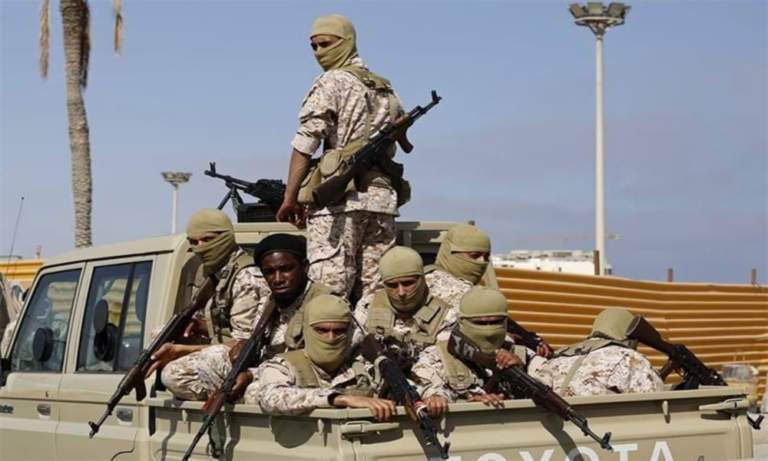
Ten people convicted of “terrorism” were executed in a military prison controlled by Khalifa Haftar’s forces, an operation shrouded in accusations of opacity and violations of the right to a fair trial.
The executions took place at the Garnada military prison, near Shahat, in eastern Libya, the military prosecutor’s office, affiliated with the authorities allied with General Khalifa Haftar, said last weekend.
According to the prosecutor’s office, the condemned men had been found guilty of terrorism-related crimes after several years of legal proceedings.
However, the exact date of the executions, the identities of the condemned men, and full trial transcripts have not been made public.
The prosecutor’s office claims that the Supreme Military Court handed down the death sentences for offenses including membership in banned organisations and participation in attacks against military personnel and civilians. It also asserts that all appeals had been exhausted and that the condemned men had legal representation.
These claims could not be independently verified. Local sources and human rights defenders present a different version of events.
According to them, some of those executed, particularly those from Derna, were prosecuted because of their political affiliations or their opposition to the eastern authorities. They denounce proceedings conducted behind closed doors before military courts, lacking the fundamental guarantees of a fair trial.
However, no independent organisation has yet published a verified list of victims or a detailed review of the cases. Garnada prison is part of the military and security apparatus under the authority of Khalifa Haftar and his family.
In May, officials in the east announced the release of 250 prisoners from this facility on the orders of the general, under the supervision of his son, Saddam Haftar.
The control exercised by the armed forces over detention facilities, military courts, and the application of the death penalty has fuelled criticism for several years regarding the lack of civilian and judicial oversight.
The executions come as Washington seeks to involve the Haftar family more closely in efforts to reunify Libyan institutions. Saddam Haftar notably met with US Secretary of State Marco Rubio in June to discuss the unification of military, political, and economic structures.
However, the Garnada case exposes the risks of this strategy: a negotiated reunification between the main centres of power could consolidate existing coercive apparatuses without guaranteeing their subordination to accountable national institutions and an independent judiciary.
MK/AK/Sf/fss/as/APA